Consider the following pairs:
Contents21
Consider the following pairs:
| Country | Resource-rich in | |
|---|---|---|
| I. | Botswana | Diamond |
| II. | Chile | Lithium |
| III. | Indonesia | Nickel |
In how many of the above rows is the given information correctly matched?
- AOnly one
- BOnly two
- CAll the three
- DNone
Show answer
Answer: (C) All the three
Let's verify each country-mineral pairing:
(I) Botswana — Diamond: CORRECT. Botswana is one of the world's largest diamond producers by value. The Jwaneng mine in Botswana is the richest diamond mine in the world. Diamonds account for about 70-80% of Botswana's export earnings and have been central to its economic development since independence. ✓
(II) Chile — Lithium: CORRECT. Chile is part of the 'Lithium Triangle' (along with Argentina and Bolivia) in South America. Chile has the world's largest lithium reserves (in the Salar de Atacama) and is one of the top lithium producers globally. Lithium is crucial for electric vehicle batteries and renewable energy storage. ✓
(III) Indonesia — Nickel: CORRECT. Indonesia is the world's largest producer of nickel ore and a major player in nickel processing. Indonesian nickel is vital for stainless steel production and, increasingly, for electric vehicle battery manufacturing. The country has banned raw nickel ore exports to encourage domestic processing and attract battery manufacturing investment. ✓
All three pairings are correct. Answer is (c).
Indonesia became the world's largest nickel producer and banned raw nickel ore exports in 2020 to force domestic processing and attract electric vehicle battery manufacturing investments.
The global shift to electric vehicles has made lithium and nickel critical minerals, elevating countries like Chile and Indonesia to strategic importance in the green energy transition.
UPSC is testing knowledge of which countries dominate specific mineral production rather than just where minerals are found.
Botswana Diamond Mining
Geography Botswana Diamond
Botswana: World's Diamond Powerhouse & Economic Transformation
Botswana is one of the world's largest diamond producers by value
Jwaneng mine is the richest diamond mine globally
Diamonds account for 70-80% of Botswana's export earnings
Diamond revenues transformed Botswana from one of the poorest to upper-middle-income country
Economic Significance
Botswana exemplifies how natural resource wealth can drive economic development when well-managed. Since independence in 1966, diamond mining has been the backbone of Botswana's economy, funding infrastructure, education, and healthcare.
Major Diamond Mines
Mine | Status | Key Feature |
|---|---|---|
Jwaneng | Active | Richest diamond mine in the world by value |
Orapa | Active | One of the largest diamond mines by area |
Letlhakane | Active | Significant kimberlite pipe mine |
Damtshaa | Active | Newer mine, opened in 2003 |
Diamond Belt Location
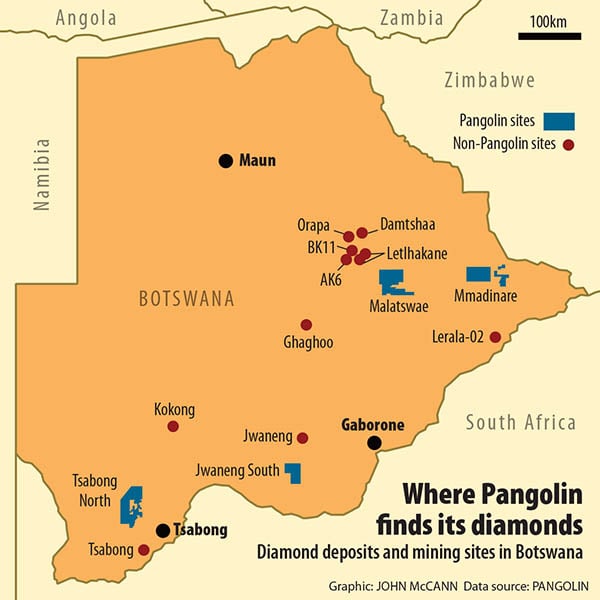
Source: The Mail & Guardian — Botswana in thrall of riches – The Mail & Guardian · mg.co.za
Global Context
De Beers partnership: Joint venture with government ensures revenue sharing
Debswana (50-50 joint venture) operates major mines
Botswana produces primarily gem-quality diamonds, not industrial diamonds
Country has successfully avoided the 'resource curse' through good governance
Trap: Don't confuse Botswana with other African diamond producers like South Africa or Democratic Republic of Congo
Trap: Botswana produces gem diamonds, not industrial diamonds (which India leads in cutting/polishing)
Trap: Jwaneng is the richest mine by value, but Orapa is larger by area
Chile Lithium Production
Geography Chile Lithium
Chile & the Lithium Triangle: Critical Mineral for Green Energy
Chile has the world's largest lithium reserves in Salar de Atacama
Part of the 'Lithium Triangle' with Argentina and Bolivia
Lithium is crucial for electric vehicle batteries and renewable energy storage
Chile is one of the top 2 global lithium producers alongside Australia
Strategic Importance
Lithium has become the 'white gold' of the green energy transition. Chile's Atacama Desert contains vast salt flats where lithium is extracted from brine, making it a geopolitically critical resource as the world shifts to electric vehicles and renewable energy storage.
Lithium Triangle Countries
Country | Main Production Area | Key Advantage | Global Share |
|---|---|---|---|
Chile | Salar de Atacama | Largest reserves, established infrastructure | ~26% of production |
Argentina | Multiple salars | Lower extraction costs | ~6% of production |
Bolivia | Salar de Uyuni | Largest potential reserves | Minimal current production |
Lithium Applications
# Lithium Uses
## Electric Vehicles
- EV batteries
- Hybrid vehicles
- Grid storage
## Electronics
- Smartphones
- Laptops
- Power tools
## Industrial
- Ceramics
- Glass production
- Pharmaceuticals
Lithium Triangle Location

Source: UBIQUE — Map of the Week: The Lithium Triangle and Its Challenges | UBIQUE · ubiqueags.org
Trap: Don't confuse Chile's brine extraction with Australia's hard rock mining of lithium
Trap: Bolivia has the largest potential reserves but Chile has the largest proven, extractable reserves
Trap: Salar de Atacama (Chile) vs Salar de Uyuni (Bolivia) - know which country has which salt flat
Indonesia Nickel Production
Geography Indonesia Nickel
Indonesia: Global Nickel Leader & Battery Supply Chain Hub
Indonesia is the world's largest producer of nickel ore
Nickel is vital for stainless steel and EV batteries
Indonesia banned raw nickel ore exports to encourage domestic processing
Major production areas include Sulawesi and Maluku
Strategic Policy
Indonesia implemented a nickel ore export ban in 2020 to force foreign companies to build processing facilities domestically. This downstream strategy aims to capture more value from raw materials and attract battery manufacturing investments, particularly from Chinese companies.
Nickel Applications & Markets
Application | Share of Demand | Key Properties | Growth Trend |
|---|---|---|---|
Stainless Steel | ~70% | Corrosion resistance, durability | Steady growth |
EV Batteries | ~15% | High energy density | Rapid expansion |
Other Alloys | ~10% | Strength, heat resistance | Stable |
Electroplating | ~5% | Surface coating | Declining |
Indonesia's Nickel Strategy
%%{init: {"flowchart": {"wrappingWidth": 460}}}%%
flowchart TD
  s1["`**Raw Ore Mining**
Extract laterite nickel ore from open-pit mines`"]
  s2["`**Export Ban (2020)**
Prohibit export of unprocessed nickel ore`"]
  s3["`**Domestic Smelting**
Force construction of local processing facilities`"]
  s4["`**Value Addition**
Attract battery and stainless steel manufacturing`"]
  s1 --> s2
  s2 --> s3
  s3 --> s4
Nickel Mining Regions
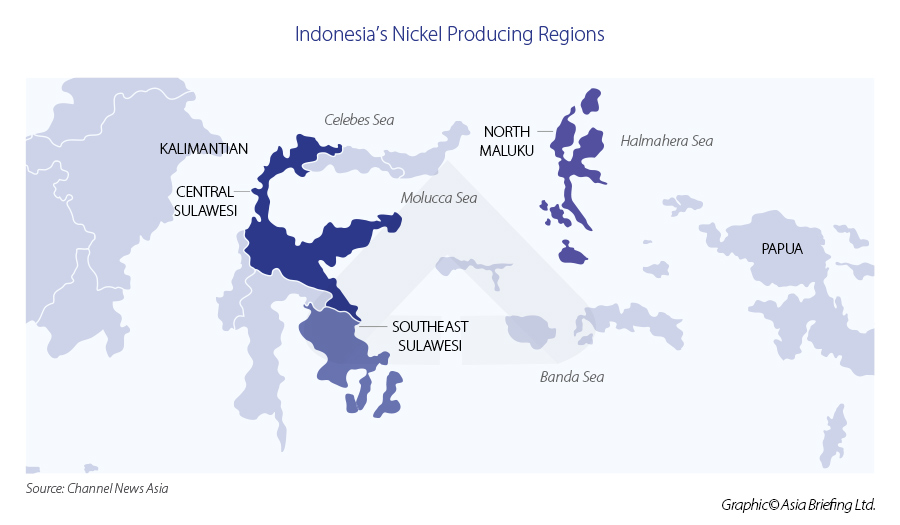
Source: ASEAN Briefing — Unleashing Nickel's Potential: Indonesia's Journey to Global ... · www.aseanbriefing.com
Global Impact
Chinese investment: Major Chinese companies built smelters after the export ban
Supply chain control: Indonesia now influences global stainless steel and EV battery prices
Environmental concerns: Rapid expansion of processing facilities raises sustainability issues
WTO dispute: Export ban challenged but upheld, setting precedent for resource nationalism
Trap: Don't confuse Indonesia (largest producer) with Philippines or New Caledonia (other major nickel sources)
Trap: Indonesia produces laterite nickel (for stainless steel & batteries), different from sulfide nickel
Trap: The export ban applies to raw ore, not processed nickel products
Global Critical Minerals Distribution
Geography
Critical Minerals: Geographic Distribution & Strategic Importance
Critical minerals are geographically concentrated in few countries
Supply chain security is a major geopolitical concern
Green energy transition increases demand for battery metals
Resource-rich countries use export policies to capture more value
Strategic Context
Critical minerals are essential for modern technology, defense systems, and green energy infrastructure. Their uneven geographic distribution creates dependencies and geopolitical tensions as countries seek to secure reliable supplies for economic and national security.
Major Critical Minerals & Top Producers
Mineral | Primary Use | Top Producer | Key Challenge |
|---|---|---|---|
Lithium | EV batteries | Chile/Australia | Brine vs hard rock extraction |
Cobalt | Battery cathodes | DR Congo | Child labor, political instability |
Rare Earths | Electronics, magnets | China | Processing monopoly |
Nickel | Stainless steel, batteries | Indonesia | Export restrictions |
Diamond | Industrial/gems | Botswana/Russia | Conflict minerals |
Copper | Electronics, infrastructure | Chile | Water scarcity in mining |
Critical Mineral Applications
# Critical Minerals
## Green Energy
- Solar panels
- Wind turbines
- EV batteries
- Grid storage
## Defense
- Precision weapons
- Communications
- Radar systems
- Satellites
## Electronics
- Smartphones
- Computers
- Semiconductors
- 5G infrastructure
## Industrial
- Stainless steel
- Alloys
- Catalysts
- Magnets
Supply Chain Risks
Concentration risk: Few countries control majority of key mineral supplies
Processing bottlenecks: China dominates refining of many critical minerals
Resource nationalism: Countries increasingly restrict raw material exports
Substitution challenges: Limited alternatives for many critical applications
Demand surge: Green transition multiplying requirements for battery metals
Trap: Don't assume largest reserves always equal largest production - technology and investment matter
Trap: Some countries are major producers but not processors (e.g., many African mineral exporters)
Trap: Strategic minerals for one country may differ based on industrial needs and existing stockpiles