India is one of the founding members of the International North-South Transport Corridor (INSTC), a multimodal transportation corridor, which will connect
Contents14
- AIndia to Central Asia to Europe via Iran
- BIndia to Central Asia via China
- CIndia to South-East Asia through Bangladesh and Myanmar
- DIndia to Europe through Azerbaijan
Show answer
Answer: (A) India to Central Asia to Europe via Iran
The International North-South Transport Corridor (INSTC) is a 7,200 km multi-modal transportation network connecting India to Russia and Northern Europe through Iran and Central Asia.
The route:
India (Mumbai port) → Arabian Sea → Iran (Bandar Abbas/Chabahar port) → Iran (road/rail through Iranian territory) → Azerbaijan/Caspian Sea → Russia → Northern Europe.
Key facts:
- Founded in 2000 by India, Iran, and Russia through an intergovernmental agreement.
- It combines ship, rail, and road transport modes.
- It reduces transit time from India to Russia by about 40% compared to the traditional route through the Suez Canal.
- Chabahar Port (developed with Indian investment) is a crucial link in this corridor.
The other options are wrong:
- Option (b) mentions China, which is not part of INSTC.
- Option (c) describes the India-Myanmar-Thailand trilateral highway/Kaladan corridor.
- Option (d) is partially right about Azerbaijan but wrong about the overall destination and route description.
Answer is (a).
INSTC reduces India-Russia trade time by 40% compared to the Suez Canal route, making it a crucial alternative trade corridor for India's connectivity to Europe and Central Asia.
India's investment in Iran's Chabahar Port and the Russia-Ukraine conflict have made INSTC strategically important as it bypasses both Pakistan and traditional European shipping routes.
UPSC is testing knowledge of India's alternative connectivity projects that reduce dependence on China's Belt and Road Initiative.
International North-South Transport Corridor (INSTC)
Geography International North-South Transport Corridor INSTC multimodal transportation corridor
INSTC: India's Gateway to Europe via Iran & Russia
INSTC connects India to Russia and Northern Europe via Iran and Central Asia
Founded in 2000 by India, Iran, and Russia
Key ports: Mumbai (India) → Bandar Abbas/Chabahar (Iran)
7,200 km multimodal network reducing transit time by 40%
What is INSTC
The International North-South Transport Corridor is a 7,200 km multimodal transportation network that provides India an alternative route to Europe and Russia, bypassing traditional Suez Canal shipping. It combines ship, rail, and road transport to reduce transit time by approximately 40%.
INSTC Route
%%{init: {"flowchart": {"wrappingWidth": 460}}}%%
flowchart TD
  s1["`**Mumbai Port (India)**
Starting point - India's major west coast port`"]
  s2["`**Arabian Sea**
Sea route across Arabian Sea`"]
  s3["`**Bandar Abbas/Chabahar (Iran)**
Iranian ports - Chabahar developed with Indian investment`"]
  s4["`**Iran Territory**
Road and rail transport through Iranian mainland`"]
  s5["`**Azerbaijan/Caspian Sea**
Transit through Azerbaijan or Caspian Sea route`"]
  s6["`**Russia**
Russian territory and rail networks`"]
  s7["`**Northern Europe**
Final destination - European markets`"]
  s1 --> s2
  s2 --> s3
  s3 --> s4
  s4 --> s5
  s5 --> s6
  s6 --> s7
Key Features
Aspect | Details |
|---|---|
Founded | 2000 - Intergovernmental agreement |
Founding Members | India, Iran, Russia |
Length | 7,200 km |
Transport Modes | Ship + Rail + Road (multimodal) |
Time Savings | 40% reduction vs Suez Canal route |
Key Indian Port | Mumbai |
Key Iranian Ports | Bandar Abbas, Chabahar |
INSTC Route Map
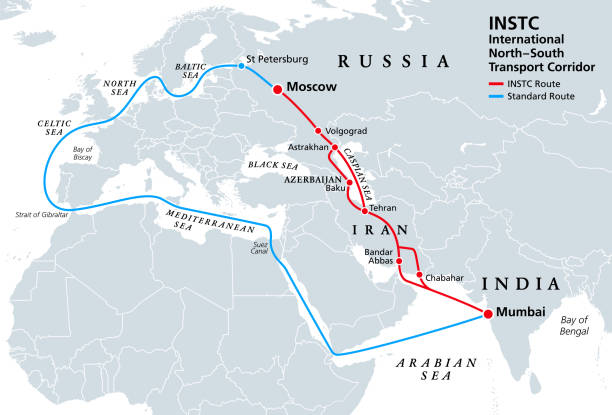
Source: Avrasya İncelemeleri Merkezi — INTERNATIONAL NORTH-SOUTH TRANSIT CORRIDOR (INSTC) - 06.07.2023 · avim.org.tr
Strategic Importance
Chabahar Port development by India is crucial for INSTC connectivity
Provides India alternative to Pakistan-controlled land routes to Central Asia
Reduces dependence on Suez Canal for Europe-bound trade
Strengthens India-Iran-Russia trilateral cooperation
Enhances access to Central Asian energy resources and markets
Trap: China is NOT part of INSTC - this eliminates option B immediately
Trap: Don't confuse with India-Myanmar-Thailand corridor (option C)
Trap: Azerbaijan is transit point, not final destination - option D is incomplete
Trap: Route goes through Iran, not directly to Europe via Azerbaijan
Remember: INSTC = India-Iran-Russia founding partnership
Chabahar Port & India's Iran Strategy
Geography Chabahar Iran
Chabahar Port: India's Gateway to Iran & Central Asia
Chabahar Port in Iran developed with Indian investment and expertise
Provides India direct access to Afghanistan and Central Asia bypassing Pakistan
Key link in INSTC and International North-South Transport Corridor
Located in Sistan-Baluchestan province of Iran
Strategic Location
Chabahar Port is located on Iran's southeastern coast near the Pakistan border, providing India a direct sea-land route to Afghanistan and Central Asia. This bypasses Pakistan-controlled territory and reduces India's dependence on Pakistani cooperation for regional trade.
India-Chabahar Partnership
Aspect | Details |
|---|---|
Investment | $85 million for port development |
Agreement | 2016 - India-Iran port development deal |
Operations | 10-year lease to operate terminals |
Connectivity | Links to Delaram-Zaranj highway (Afghanistan) |
Bypass Route | Alternative to Pakistan-controlled routes |
INSTC Role | Key Iranian port for North-South corridor |
Geopolitical Significance
Counters China's Gwadar Port development in Pakistan
Provides India direct access to Afghan reconstruction projects
Enables trade with Central Asian republics (Uzbekistan, Tajikistan)
Strengthens India-Iran strategic partnership despite US sanctions
Part of India's Connect Central Asia policy
Chabahar Location
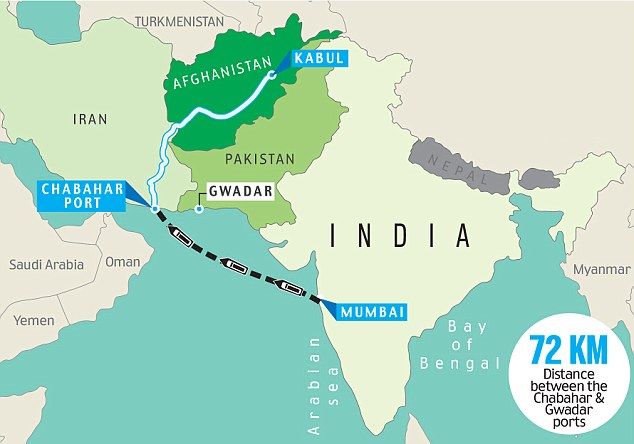
Source: Stagecraft and Statecraft — Chabahar: Gateway to Afghanistan and Central Asia ... · chellaney.net
India's Major Transport Corridors
Geography
India's Regional Transport Corridor Initiatives
India-Myanmar-Thailand Trilateral Highway connects India to Southeast Asia
Kaladan Multi-Modal Transit links Northeast India via Myanmar
INSTC connects India to Europe via Iran-Russia route
Bangladesh-Bhutan-India-Nepal Motor Vehicle Agreement for regional connectivity
Major Connectivity Projects
Corridor | Route | Purpose | Status |
|---|---|---|---|
INSTC | India-Iran-Russia-Europe | Alternative to Suez Canal | Operational |
India-Myanmar-Thailand Highway | Moreh-Mandalay-Mae Sot | Southeast Asia access | Under construction |
Kaladan Multi-Modal | Kolkata-Sittwe-Mizoram | Northeast connectivity | Under development |
BBIN Motor Vehicle Agreement | Bangladesh-Bhutan-India-Nepal | Regional integration | Partially operational |
Iran-Afghanistan-India Transit | Via Chabahar Port | Central Asia trade | Limited operations |
India's Connectivity Vision
# India's Transport Corridors
## Westward (INSTC)
- Iran-Russia route
- Europe access
- Chabahar Port
## Eastward (Act East)
- Myanmar-Thailand
- ASEAN integration
- Kaladan corridor
## Northward
- Central Asia
- Afghanistan trade
- Energy imports
## Regional (South Asia)
- BBIN Agreement
- SAARC connectivity
- Cross-border tradeDon't confuse INSTC (Iran route) with India-Myanmar-Thailand highway
Kaladan corridor is for Northeast India, not Central Asia connectivity
BBIN involves Bangladesh-Bhutan-India-Nepal, not Myanmar or China
Gwadar Port is Pakistan-China project, Chabahar is India-Iran project