Who among the following led a successful military campaign against the kingdom of Srivijaya, the powerful maritime State, which ruled the Malay Peninsula, Sumatra, Java and the neighbouring islands?
Contents22
- AAmoghavarsha (Rashtrakuta)
- BPrataparudra (Kakatiya)
- CRajendra I (Chola)
- DVishnuvardhana (Hoysala)
Show answer
Answer: (C) Rajendra I (Chola)
Rajendra I (also known as Rajendra Chola I) was one of the greatest rulers of the Chola dynasty, reigning from 1014 to 1044 CE.
He is famous for his extraordinary naval expeditions, particularly the campaign against the Srivijaya Empire.
The Srivijaya Empire was a powerful maritime kingdom based in Sumatra (modern-day Indonesia) that controlled the strategically vital Strait of Malacca — the key shipping route between India and China.
Around 1025 CE, Rajendra I launched a massive naval campaign against Srivijaya. His navy sailed across the Bay of Bengal and attacked multiple Srivijaya territories including parts of the Malay Peninsula, Sumatra, and nearby islands.
Why did he attack? The Srivijaya Empire was disrupting Chola trade routes to China and Southeast Asia. By defeating them, Rajendra I secured Chola commercial interests in the region.
This naval expedition is remarkable because it was one of the few instances in ancient Indian history where a kingdom projected military power overseas across an ocean. It demonstrates the Chola dynasty's exceptional naval capabilities.
The other rulers listed — Amoghavarsha (Rashtrakuta), Prataparudra (Kakatiya), and Vishnuvardhana (Hoysala) — were all important in peninsular India but did not conduct overseas military campaigns.
Answer is (c).
Rajendra I's 1025 CE naval campaign against Srivijaya was one of the rare instances in ancient Indian history where a kingdom projected military power across oceans to secure trade routes.
The campaign targeted Srivijaya's control over the Strait of Malacca, the crucial shipping route between India and China, demonstrating how medieval Indian rulers understood maritime trade geopolitics.
UPSC is testing whether students can distinguish between rulers who fought land-based campaigns in peninsular India versus those who conducted overseas naval expeditions.
Rajendra I & Naval Expeditions
Ancient And Medieval History Rajendra I Chola
Rajendra I (Chola): Naval Expeditions & Southeast Asian Campaigns
Rajendra I (1014-1044 CE) launched successful naval campaign against Srivijaya Empire around 1025 CE
Attacked across Bay of Bengal to secure Chola trade routes to China and Southeast Asia
One of the few ancient Indian rulers to project military power overseas
Conquered parts of Malay Peninsula, Sumatra, and nearby islands
Historical Context
Rajendra I was the son of Rajaraja I and ruled the Chola Empire from 1014-1044 CE. He inherited a powerful naval tradition and expanded Chola influence beyond the Indian subcontinent — making him unique among medieval Indian rulers.
Rajendra I's Major Campaigns
Campaign | Target | Year (Approx) | Outcome |
|---|---|---|---|
Srivijaya Expedition | Malay Peninsula, Sumatra, Java | 1025 CE | Secured trade routes to China |
Northern Campaign | Gangetic Plains | 1023-1024 CE | Reached Ganges, took title 'Gangaikonda' |
Ceylon Campaign | Sri Lanka | 1017-1018 CE | Completed conquest started by Rajaraja I |
Kalinga Campaign | Eastern India | 1021-1022 CE | Extended Chola power to Bay of Bengal coast |
Why the Srivijaya Campaign Matters
Trade Route Control: Srivijaya controlled the Strait of Malacca — the vital shipping lane between India and China
Economic Motive: Srivijaya was disrupting Chola merchants' access to Southeast Asian and Chinese markets
Naval Power Demonstration: Showed Chola navy could project power across 1000+ km of ocean
Diplomatic Impact: Established Chola influence in Southeast Asia for decades
Geographic Scope
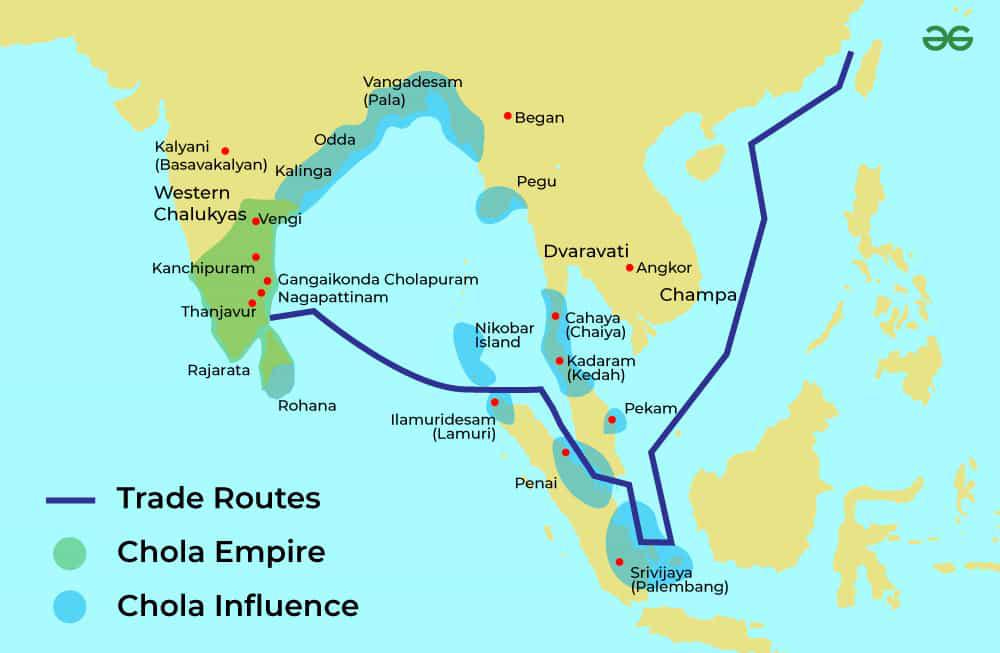
Source: Murray Hunter - Substack — Reassessing the Chola naval expeditions to Southeast Asia: A ... · murrayhunter.substack.com
Question Context
This UPSC question tests knowledge of which ruler conducted overseas military campaigns. Only Rajendra I among the given options projected naval power beyond India's shores to Southeast Asia.
Don't confuse Rajendra I with Rajaraja I — both were great Chola naval rulers
Amoghavarsha (Rashtrakuta) was powerful but focused on Deccan, not overseas campaigns
Remember: Srivijaya was based in Sumatra (Indonesia), not peninsular India
1025 CE is the key date for the Srivijaya expedition
Srivijaya Maritime Empire
Ancient And Medieval History Srivijaya Malay Peninsula Sumatra Java
Srivijaya Empire: Maritime Power of Southeast Asia
Srivijaya Empire (7th-13th centuries) controlled Strait of Malacca and surrounding islands
Based in Sumatra (modern Indonesia), ruled Malay Peninsula, Java, and neighboring islands
Dominated India-China trade routes through maritime control
Defeated by Rajendra I's naval expedition around 1025 CE
Strategic Importance
Srivijaya was a thalassocracy (sea-based empire) that controlled the world's most important maritime trade route. The Strait of Malacca between Sumatra and Malay Peninsula was the only practical shipping lane connecting the Indian Ocean with the South China Sea.
Srivijaya vs Other Medieval Powers
Empire | Base | Power Type | Peak Period | Relationship with India |
|---|---|---|---|---|
Srivijaya | Sumatra, Indonesia | Maritime/Naval | 7th-11th centuries | Controlled India-China trade |
Chola | Tamil Nadu, India | Land + Naval | 9th-13th centuries | Challenged Srivijaya control |
Khmer | Cambodia | Land-based | 9th-15th centuries | Limited maritime influence |
Majapahit | Java, Indonesia | Maritime | 13th-16th centuries | Succeeded Srivijaya power |
Srivijaya's Territorial Control
# Srivijaya Empire
## Core Territory
- Sumatra (Capital: Palembang)
- Southern Malay Peninsula
## Extended Control
- Parts of Java
- Bangka-Belitung Islands
- Southern Thailand
## Trade Control
- Strait of Malacca
- Sunda Strait
- India-China shipping routes
Why Cholas Attacked Srivijaya
Trade Disruption: Srivijaya was charging high tolls and restricting Chola merchants' access to Chinese markets
Economic Competition: Both empires wanted control over lucrative spice trade and China trade
Strategic Chokepoint: Whoever controlled the Strait of Malacca controlled Asia's maritime commerce
Commercial Intelligence: Chola merchants provided Rajendra I with detailed knowledge of Srivijaya's ports and defenses
Strategic Location
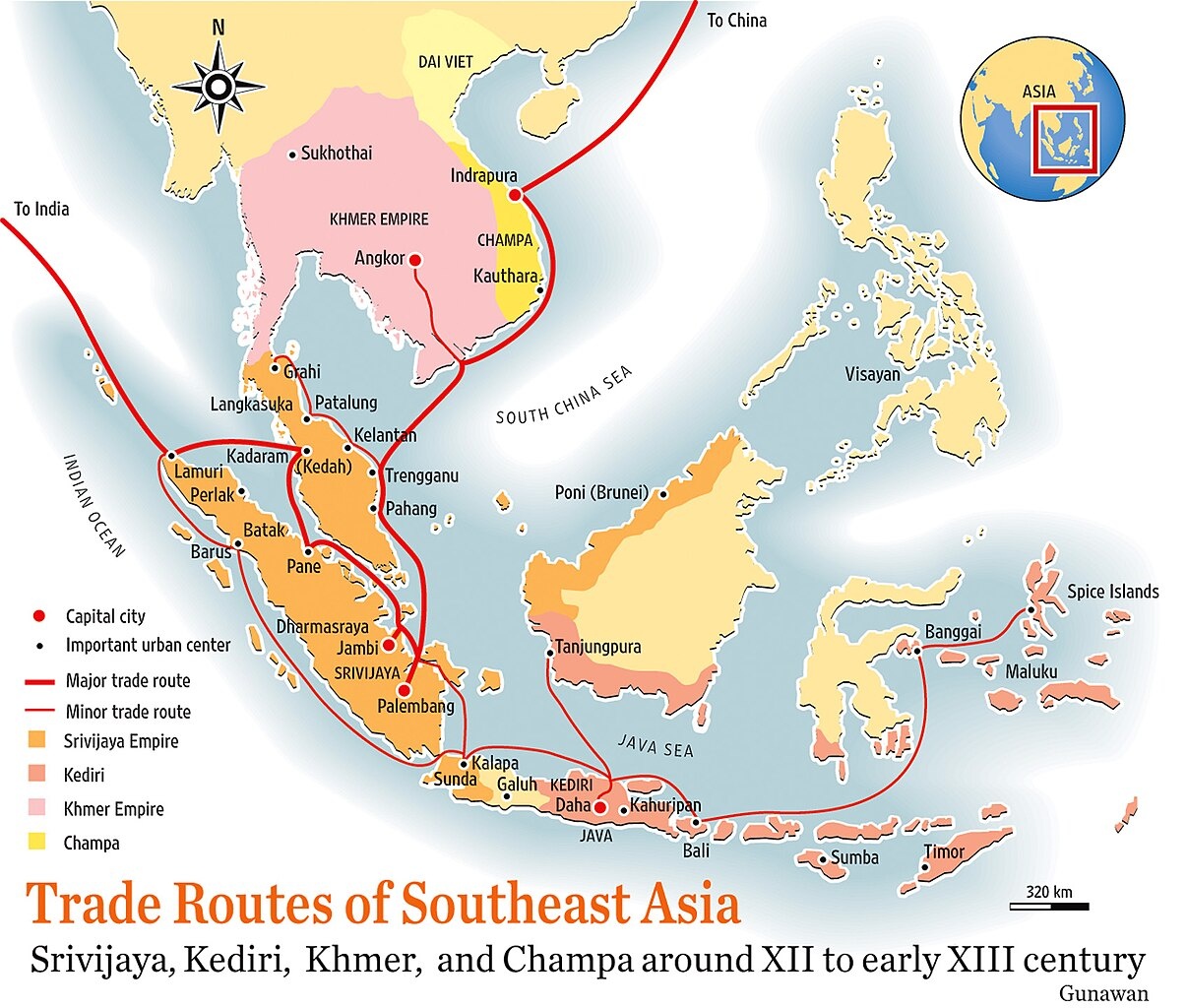
Source: Facts and Details — SRIVIJAYA KINGDOM: HISTORY, BUDDHISM, TRADE, ART | Facts and ... · factsanddetails.com
Don't locate Srivijaya in India — it was based in Sumatra (Indonesia)
Malay Peninsula was part of Srivijaya, but capital was in Sumatra
Srivijaya was maritime power, not land-based like most Indian kingdoms
Strait of Malacca (not Strait of Hormuz) was Srivijaya's key strategic asset
Chola Naval Supremacy
Ancient And Medieval History
Chola Naval Power: India's Greatest Maritime Empire
Cholas built ancient India's most powerful navy under Rajaraja I and Rajendra I
Controlled Bay of Bengal and projected power to Southeast Asia and Sri Lanka
Only Indian dynasty to conduct successful overseas military campaigns
Naval power supported extensive Indian Ocean trade network
Naval Innovation
The Chola navy was revolutionary for medieval India. Most Indian kingdoms focused on land armies, but Cholas developed shipbuilding technology, naval tactics, and maritime logistics that allowed them to fight thousands of kilometers from home.
Chola Naval Achievements
Campaign | Ruler | Target | Significance |
|---|---|---|---|
Sri Lanka Conquest | Rajaraja I & Rajendra I | Anuradhapura Kingdom | Complete control of island (1017-1070 CE) |
Srivijaya Expedition | Rajendra I | Sumatra, Malay Peninsula | Secured Southeast Asian trade routes (1025 CE) |
Maldives Control | Rajaraja I | Maldive Islands | Dominated Arabian Sea trade routes |
Bengal Campaign | Rajendra I | Eastern India | Naval support for land campaign via rivers |
How Chola Naval Power Developed
%%{init: {"flowchart": {"wrappingWidth": 460}}}%%
flowchart TD
  s1["`**Foundation**
**Vijayalaya Chola** establishes dynasty (850 CE), focuses on land power`"]
  s2["`**Naval Investment**
**Rajaraja I** (985-1014 CE) builds shipyards, recruits naval expertise`"]
  s3["`**Local Dominance**
Chola navy conquers **Sri Lanka** and controls **Palk Strait**`"]
  s4["`**Regional Expansion**
**Rajendra I** projects power across **Bay of Bengal** to Southeast Asia`"]
  s5["`**Trade Network**
Naval supremacy supports Chola merchant colonies from **Maldives to Java**`"]
  s1 --> s2
  s2 --> s3
  s3 --> s4
  s4 --> s5
What Made Chola Navy Unique
Geographic Advantage: Long Coromandel Coast provided natural harbors and shipbuilding timber
Merchant Support: Wealthy Tamil merchant guilds funded naval expeditions for trade protection
Technical Innovation: Developed large warships capable of ocean voyages with soldiers and supplies
Intelligence Network: Chola merchants in Southeast Asia provided military intelligence
Administrative System: Created naval districts with dedicated shipyards and admirals
Cholas were the naval power — don't confuse with land-focused Rashtrakutas or Pallavas
Both Rajaraja I and Rajendra I were naval rulers, but Rajendra I conducted the Srivijaya campaign
Chola navy dominated Bay of Bengal, not Arabian Sea (that was secondary)
Sri Lanka was conquered first, Southeast Asia came later under Rajendra I
Medieval Indian Rulers Comparison
Ancient And Medieval History Amoghavarsha Prataparudra Vishnuvardhana
Medieval Peninsular Rulers: Amoghavarsha, Prataparudra & Vishnuvardhana
Amoghavarsha I (Rashtrakuta) ruled Deccan plateau, focused on land-based power
Prataparudra II (Kakatiya) defended Warangal against Delhi Sultanate invasions
Vishnuvardhana (Hoysala) controlled Karnataka, fought Cholas and Chalukyas
None conducted overseas military campaigns like Rajendra I
Comparison with Rajendra I
Ruler | Dynasty | Period | Capital | Military Focus | Major Achievements |
|---|---|---|---|---|---|
Rajendra I | Chola | 1014-1044 CE | Thanjavur | Naval + Land | Overseas campaigns, Srivijaya expedition |
Amoghavarsha I | Rashtrakuta | 814-878 CE | Manyakheta | Land-based | Deccan consolidation, patronage of arts |
Prataparudra II | Kakatiya | 1289-1323 CE | Warangal | Defensive | Resisted Alauddin Khilji and Tughluq invasions |
Vishnuvardhana | Hoysala | 1108-1152 CE | Halebid | Land warfare | Defeated Cholas at Talakad (1116 CE) |
Geographic Spheres of Influence
# Medieval South India
## Chola Territory
- Tamil Nadu
- Eastern Deccan
- Sri Lanka
- Southeast Asia (naval)
## Rashtrakuta Territory
- Western Deccan
- Maharashtra
- Northern Karnataka
- Gujarat
## Kakatiya Territory
- Telangana
- Eastern Andhra Pradesh
- Warangal region
## Hoysala Territory
- Southern Karnataka
- Parts of Tamil Nadu
- Mysore plateau
Why These Rulers Didn't Conduct Naval Campaigns
Amoghavarsha: Rashtrakuta power was based in inland Deccan — focused on land control and trade routes
Prataparudra: Kakatiya kingdom faced constant Delhi Sultanate pressure — defensive warfare dominated
Vishnuvardhana: Hoysala territory was landlocked Karnataka — no significant coastal access
Geographic Limitation: Only Cholas had both the coastal base and merchant network for naval expeditions
Historical Context
While all these rulers were powerful in their regions, naval expeditions required specific conditions: coastal territory, maritime trade interests, shipbuilding capability, and merchant support. Only the Cholas combined all these factors successfully.
Amoghavarsha I was a great Rashtrakuta ruler but never conducted naval campaigns
Prataparudra is famous for defending against Delhi Sultanate, not overseas expeditions
Vishnuvardhana fought land battles against Cholas, but didn't have naval power
Don't confuse different Vishunuvardanas — this refers to Hoysala Vishnuvardhana (12th century)