With reference to the planet Earth, consider the following statements: I. Rain forests produce more oxygen than that produced by oceans. II. Marine phytoplankton and photosynthetic bacteria produce about 50% of world's oxygen. III. Well-oxygenated surface water contains several folds higher oxygen than that in atmospheric air. Which of the statements given above is/are correct?
Contents17
- AI and II
- BII only
- CI and III
- DNone of the above statements is correct
Show answer
Answer: (B) II only
(I) 'Rainforests produce more oxygen than oceans' — INCORRECT.
This is a common misconception.
Oceans produce more oxygen than all land-based forests combined.
Marine phytoplankton (tiny floating plants/algae) and photosynthetic cyanobacteria in the oceans are responsible for 50-80% of Earth's oxygen production.
Tropical rainforests, while important, also consume much of the oxygen they produce through respiration and decomposition.
✗
(II) 'Marine phytoplankton and photosynthetic bacteria produce about 50% of world's oxygen' — CORRECT.
This is the key fact.
Phytoplankton like diatoms and cyanobacteria like Prochlorococcus (the most abundant photosynthetic organism on Earth) carry out photosynthesis in the ocean surface waters and produce roughly 50% or more of global oxygen.
✓
(III) 'Well-oxygenated surface water contains several folds higher oxygen than atmospheric air' — INCORRECT.
It's actually the opposite!
Atmospheric air contains about 21% oxygen (210,000 ppm), while even well-oxygenated surface water contains only about 6-8 mg/L of dissolved oxygen.
Water holds far LESS oxygen than air because gases dissolve poorly in water compared to their concentration in the atmosphere.
✗
Only Statement II is correct.
Answer is (b).
Oceans produce 50-80% of Earth's oxygen through marine phytoplankton and cyanobacteria, not rainforests as commonly believed.
Climate change and ocean warming reduce phytoplankton populations, making ocean oxygen production a critical environmental concern in recent years.
The question tests whether students know basic atmospheric vs aquatic oxygen concentrations and can distinguish between oxygen production myths and facts.
Marine Oxygen Production
Environment Marine phytoplankton photosynthetic bacteria oceans
Marine Oxygen Production: Phytoplankton & Ocean's Role
Oceans produce 50-80% of Earth's oxygen through marine phytoplankton and cyanobacteria
Prochlorococcus is the most abundant photosynthetic organism on Earth
Oceans produce more oxygen than all rainforests combined
Marine photosynthesis occurs in euphotic zone (sunlight penetration zone)
The oceans are Earth's primary oxygen factory, not forests. Marine phytoplankton — tiny floating plants and algae — along with photosynthetic bacteria like cyanobacteria dominate global oxygen production through photosynthesis in surface waters.
Key Marine Oxygen Producers
Organism | Type | Size | Key Role |
|---|---|---|---|
Prochlorococcus | Cyanobacteria | 0.5-0.7 micrometers | Most abundant photosynthetic organism globally |
Diatoms | Phytoplankton | 2-200 micrometers | Major oxygen producers with silica shells |
Dinoflagellates | Phytoplankton | 5-2000 micrometers | Mobile algae with flagella |
Coccolithophores | Phytoplankton | 5-100 micrometers | Calcium carbonate plates, important in carbon cycle |
Why Oceans Dominate Oxygen Production
Surface area: Oceans cover 71% of Earth's surface vs forests covering ~31% of land
Year-round production: Marine photosynthesis continues throughout the year in tropical/subtropical waters
High density: Phytoplankton biomass per unit area often exceeds forest biomass
Efficient conversion: Marine organisms convert CO₂ to O₂ without woody tissue formation
Global Ocean Productivity
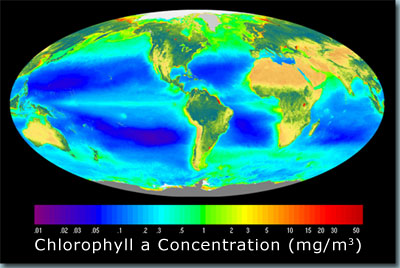
Source: Ocean Tracks — Chlorophyll | Ocean Tracks · oceantracks.org
Trap: 'Rainforests produce more oxygen than oceans' — WRONG. Oceans win decisively.
Confusion: Amazon as 'lungs of Earth' — misleading because it consumes most oxygen it produces through respiration.
Numbers game: Marine sources produce 50-80% of oxygen, not just 50% as the minimum.
Rainforest Oxygen Production
Environment Rain forests oxygen
Rainforest Oxygen Production: Reality vs Myth
Rainforests have near-zero net oxygen production due to high respiration rates
Amazon rainforest consumes almost all oxygen it produces through plant/soil respiration
Mature forests are carbon neutral, not oxygen producers
Young growing forests produce more oxygen than mature ones
The 'lungs of Earth' label for Amazon rainforest is misleading. While rainforests do photosynthesize and release oxygen during the day, they also consume massive amounts through plant respiration and decomposition of dead organic matter.
Rainforest Oxygen Cycle
%%{init: {"flowchart": {"wrappingWidth": 460}}}%%
flowchart TD
  s1["`**Photosynthesis (Day)**
Trees absorb CO₂, release O₂ using sunlight`"]
  s2["`**Plant Respiration (24/7)**
Trees consume O₂ for cellular energy, release CO₂`"]
  s3["`**Decomposition (24/7)**
Bacteria/fungi break down dead matter, consume O₂`"]
  s4["`**Net Result**
**Near-zero oxygen production** in mature forests`"]
  s1 --> s2
  s2 --> s3
  s3 --> s4
Oxygen Production Comparison
Ecosystem | Oxygen Production | Oxygen Consumption | Net Contribution |
|---|---|---|---|
Mature Rainforest | High (day only) | Very High (24/7) | Near Zero |
Young Forest | High | Moderate | Positive |
Ocean Surface | Very High | Low | Very High |
Grasslands | Moderate | Low | Moderate |
Why Mature Forests Don't Produce Net Oxygen
Ecosystem equilibrium: Mature forests reach balance between photosynthesis and respiration
High biomass turnover: Constant death and decomposition of plants consumes oxygen
Dense canopy: Lower light penetration reduces photosynthetic efficiency in understory
Soil respiration: Rich forest soils have high microbial activity consuming oxygen
Major trap: 'Amazon = lungs of Earth' sounds correct but net oxygen production is near zero
Confusion: Don't equate photosynthesis with net oxygen production — respiration matters too
Statement I trap: 'Rainforests produce MORE than oceans' — absolutely wrong
Dissolved Oxygen in Water
Environment surface water oxygen atmospheric air
Dissolved Oxygen in Water vs Atmospheric Oxygen
Atmospheric air contains 21% (210,000 ppm) oxygen
Well-oxygenated surface water contains only 6-8 mg/L dissolved oxygen
Water holds far less oxygen than air due to poor gas solubility
Cold water dissolves more oxygen than warm water
A critical misconception is that water can hold more oxygen than air. The opposite is true — gases dissolve poorly in water. Even 'well-oxygenated' water contains tiny amounts of dissolved oxygen compared to atmospheric concentrations.
Oxygen Concentration Comparison
Medium | Oxygen Content | Units | Relative Amount |
|---|---|---|---|
Atmospheric Air | 21% | Volume percentage | 210,000 ppm |
Well-oxygenated Water | 6-8 mg/L | Mass per volume | 6-8 ppm |
Saturated Water (0°C) | 14.6 mg/L | Mass per volume | 14.6 ppm |
Polluted Water | <4 mg/L | Mass per volume | <4 ppm |
Factors Affecting Dissolved Oxygen
Temperature: Cold water dissolves more oxygen (inverse relationship)
Pressure: Higher atmospheric pressure increases oxygen solubility
Salinity: Saltwater dissolves less oxygen than freshwater
Turbulence: Wave action and waterfalls increase oxygen mixing
Biological activity: Photosynthesis adds O₂, respiration removes it
How Oxygen Enters Water
%%{init: {"flowchart": {"wrappingWidth": 460}}}%%
flowchart TD
  s1["`**Atmospheric Diffusion**
O₂ dissolves from air at water surface`"]
  s2["`**Photosynthesis**
Aquatic plants release O₂ during day`"]
  s3["`**Mechanical Mixing**
Waves, currents, waterfalls add O₂`"]
  s4["`**Equilibrium Reached**
Water becomes 'saturated' with dissolved O₂`"]
  s1 --> s2
  s2 --> s3
s3 --> s4Statement III trap: 'Surface water has several folds HIGHER oxygen' — completely backwards
Unit confusion: Don't compare 21% (air) with 8 mg/L (water) directly — air wins massively
'Well-oxygenated' misleading: Even the best water has 26,000 times less oxygen than air
Global Oxygen Cycle
Environment oxygen world's oxygen
Global Oxygen Cycle: Sources, Sinks & Distribution
Photosynthesis by plants and algae is the primary source of atmospheric oxygen
Respiration and decomposition are the main oxygen sinks
Oxygen concentration has remained stable at 21% for millions of years
Oceanic contribution dominates terrestrial contribution in oxygen production
Oxygen Cycle Components
# Global Oxygen Cycle
## Sources (+O₂)
- Marine Phytoplankton (50-80%)
- Terrestrial Plants (20-50%)
- Photosynthetic Bacteria
## Sinks (-O₂)
- Plant Respiration
- Animal Respiration
- Decomposition
- Rock Weathering
- Combustion
## Reservoirs
- Atmosphere (21%)
- Dissolved in Oceans
- Bound in Rocks
- Biological Tissues
Oxygen Production by Source
Source | Contribution % | Key Organisms | Geographic Distribution |
|---|---|---|---|
Marine Phytoplankton | 50-80% | Prochlorococcus, Diatoms | Ocean surface waters globally |
Tropical Forests | 15-20% | Trees, understory plants | Amazon, Congo, Southeast Asia |
Temperate Forests | 10-15% | Deciduous & coniferous trees | North America, Europe, Asia |
Grasslands & Others | 5-10% | Grasses, crops, algae | Prairies, agricultural lands |
Oxygen Cycle Balance
Geological timescale: O₂ levels fluctuated dramatically over Earth's history (0% to 35%)
Current stability: Human timescale shows remarkable equilibrium between sources and sinks
Seasonal variation: Northern hemisphere shows slight O₂ fluctuations due to plant growth cycles
Climate change impact: Warming oceans may reduce phytoplankton productivity
Oxygen Cycle Diagram
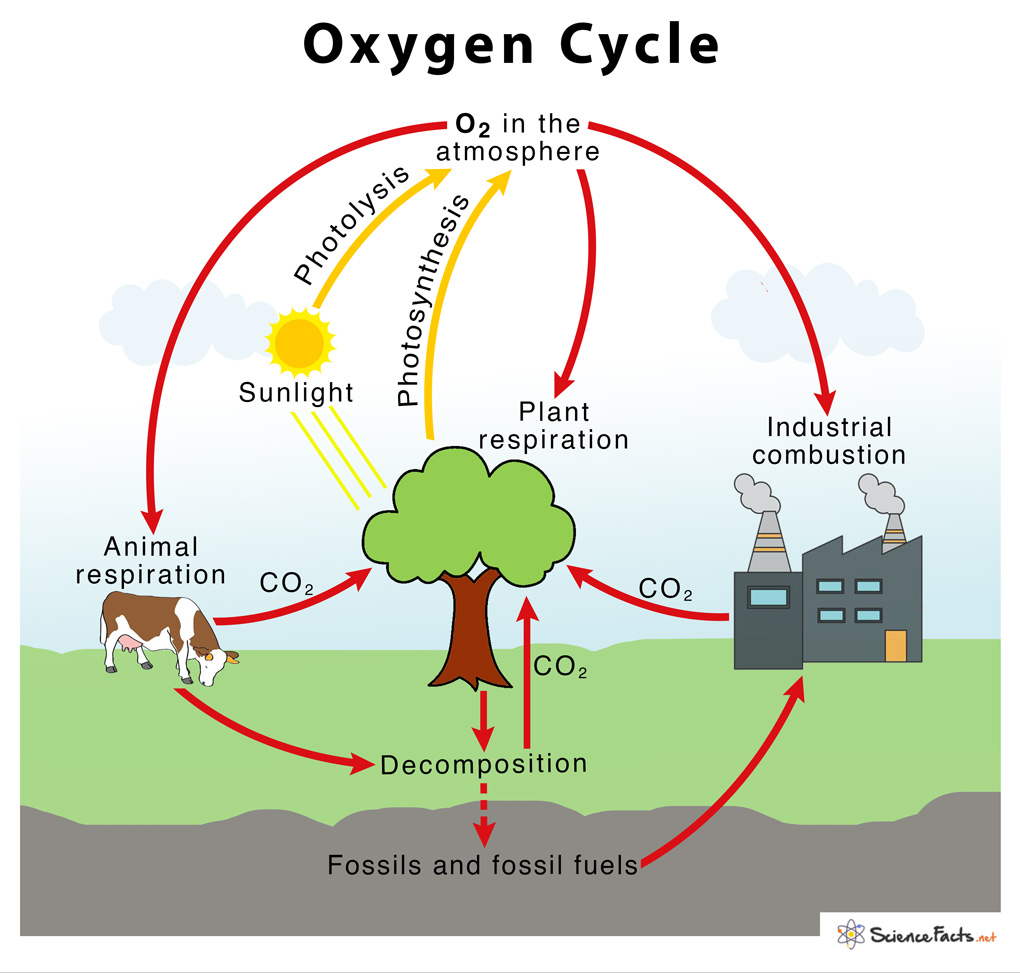
Source: Science Facts — Oxygen Cycle With Diagram – Definition, Steps & Importance · www.sciencefacts.net
Source ranking: Oceans > Forests, not the reverse that many students assume
Net vs gross production: Mature ecosystems may have high gross production but near-zero net production
Stability misconception: O₂ levels appear stable but depend on delicate source-sink balance