Consider the following statements: Statement I: Scientific studies suggest that a shift is taking place in the Earth's rotation and axis. Statement II: Solar flares and associated coronal mass ejections bombarded the Earth's outermost atmosphere with tremendous amount of energy. Statement III: As the Earth's polar ice melts, the water tends to move towards the equator. Which one of the following is correct in respect of the above statements?
Contents18
- ABoth Statements II and III are correct and both of them explain Statement I
- BBoth Statement II and Statement III are correct but only one of them explains Statement I
- COnly one of the Statement II and III is correct and that explains Statement I
- DNeither Statement II nor Statement III is correct
Show answer
Answer: (B) Both Statement II and Statement III are correct but only one of them explains Statement I
Statement I (Assertion): A shift is taking place in Earth's rotation and axis.
Statement II: Solar flares and coronal mass ejections bombard Earth's atmosphere with energy.
— CORRECT as a standalone fact.
Solar flares do release tremendous energy that affects Earth's magnetosphere and can disrupt communications.
However, this energy affects the outermost atmosphere (ionosphere/magnetosphere) and does NOT cause long-term changes in Earth's rotation or axial shift.
So while the statement is true, it does NOT explain Statement I.
✓ True but does NOT explain I.
Statement III: As polar ice melts, water moves towards the equator.
— CORRECT.
When massive ice sheets at the poles melt, the water redistributes toward the equator due to gravity and Earth's rotation.
This shifts mass from the poles to the equator, which slows Earth's rotation (like a spinning ice skater extending their arms) and causes the rotational axis to wobble — a phenomenon called 'polar motion.'
NASA studies have confirmed this link between ice melt and changes in Earth's rotation.
✓ True AND explains I.
Both statements are factually correct, but only Statement III explains the rotational shift.
Answer is (b).
NASA and other agencies have documented measurable changes in Earth's rotation speed and polar motion, particularly linked to climate change effects like ice sheet melting.
Climate change became a major geophysical topic around 2023-2024, with studies showing how melting Greenland and Antarctic ice affects Earth's rotation by redistributing mass from poles to equator.
This tests understanding of mass redistribution physics - when mass moves from poles toward equator, Earth's rotation slows and axis shifts, similar to how a spinning ice skater slows when extending their arms.
Earth's Rotation & Axis Changes
Geography Earth's rotation axis shift
Earth's Rotation & Axis Changes: Causes & Mechanisms
Earth's rotational axis shifts due to mass redistribution from ice melt and water movement
Polar motion occurs when mass moves from poles to equator, slowing rotation
Conservation of angular momentum explains why mass redistribution affects rotation speed
NASA studies have confirmed link between climate change and rotational changes
What Causes Rotational Changes
Earth's rotation and axis are not fixed — they change when mass redistributes across the planet. The primary driver today is ice melt from polar regions, which moves water toward the equator and alters Earth's moment of inertia.
Ice Melt → Rotational Change
%%{init: {"flowchart": {"wrappingWidth": 460}}}%%
flowchart TD
  s1["`**Polar ice sheets melt**
Greenland and Antarctic ice loses mass due to warming`"]
  s2["`**Water redistributes toward equator**
Meltwater flows to oceans and spreads globally`"]
  s3["`**Earth's mass distribution changes**
More mass at equator, less at poles`"]
  s4["`**Rotational axis shifts (polar motion)**
Axis wobbles as Earth adjusts to new mass distribution`"]
  s5["`**Rotation speed decreases**
Conservation of angular momentum slows Earth's spin`"]
  s1 --> s2
  s2 --> s3
  s3 --> s4
  s4 --> s5
Key Scientific Evidence
NASA's Jet Propulsion Laboratory has measured polar motion using satellite data since the 1980s
The rotational axis has shifted approximately 4 meters since 1900 due to various mass redistributions
Chandler wobble is the natural 14-month cycle of polar motion, but human activities now add additional shifts
Day length is increasing by about 1.7 milliseconds per century partly due to ice melt
Major earthquakes can also cause sudden but smaller shifts in Earth's rotation
Trap: Solar flares affect Earth's magnetosphere but do NOT cause long-term rotational changes
Trap: Don't confuse magnetic pole shift (magnetic field changes) with rotational axis shift (physical rotation changes)
Trap: Precession is a 26,000-year cycle, but polar motion refers to shorter-term wobbles
Trap: Statement II was factually correct about solar flares but did NOT explain Statement I about rotation
Solar Flares & Coronal Mass Ejections
Geography Solar flares coronal mass ejections outermost atmosphere
Solar Flares & Coronal Mass Ejections: Space Weather Effects
Solar flares are intense bursts of electromagnetic radiation from the Sun's surface
Coronal Mass Ejections (CMEs) release billions of tons of plasma into space
Both primarily affect Earth's magnetosphere and ionosphere, not rotation
Can disrupt satellite communications and cause auroras
What Are Solar Flares & CMEs
Solar flares are sudden releases of electromagnetic energy from the Sun's surface, while Coronal Mass Ejections are massive bursts of plasma and magnetic field released from the Sun's corona. Both can travel to Earth and interact with our planet's magnetic field.
Solar Flares vs CMEs
Aspect | Solar Flares | Coronal Mass Ejections |
|---|---|---|
What it is | Electromagnetic radiation burst | Plasma & magnetic field ejection |
Travel time to Earth | 8 minutes (speed of light) | 1-3 days (varies by speed) |
Primary effect | Disrupts ionosphere | Disturbs magnetosphere |
Duration | Minutes to hours | Can last several days |
Main impact | Radio blackouts | Geomagnetic storms, auroras |
Effects on Earth's Atmosphere
Impact Earth's outermost atmospheric layers — ionosphere (60-1000 km) and magnetosphere
Can cause radio blackouts by disrupting ionospheric communication paths
Trigger geomagnetic storms that produce auroras at higher latitudes
May damage satellite electronics and disrupt GPS navigation systems
Do NOT affect Earth's rotation, axis, or long-term geological processes
Trap: Solar activity affects atmosphere but does NOT cause rotational axis shifts
Trap: Don't confuse short-term atmospheric effects with long-term rotational changes
Trap: Magnetosphere disruption ≠ physical rotation disruption
Trap: Statement II was scientifically accurate but irrelevant to explaining rotational shifts
Polar Ice Melt & Mass Redistribution
Geography polar ice melts water equator
Polar Ice Melt & Global Mass Redistribution Effects
Polar ice melt redistributes water from poles toward equatorial regions
Water movement affects Earth's moment of inertia and rotation speed
Greenland and Antarctic ice sheets are primary contributors to mass redistribution
Causes both sea level rise and rotational axis changes
How Ice Melt Redistributes Mass
When polar ice sheets melt, water that was concentrated at Earth's poles flows into oceans and redistributes globally. This moves mass from the poles toward the equator, fundamentally changing how Earth's mass is distributed and affecting rotation.
Global Effects of Ice Melt
# Polar Ice Melt
## Physical Effects
- **Sea level rise**
- **Coastal flooding**
- **Ocean circulation changes**
- **Salinity changes**
## Rotational Effects
- **Axis wobble (polar motion)**
- **Rotation slowing**
- **Day length increase**
- **Angular momentum change**
## Primary Sources
- **Greenland ice sheet**
- **Antarctic ice sheet**
- **Arctic sea ice**
- **Mountain glaciers**
Global Ice Sheet Distribution
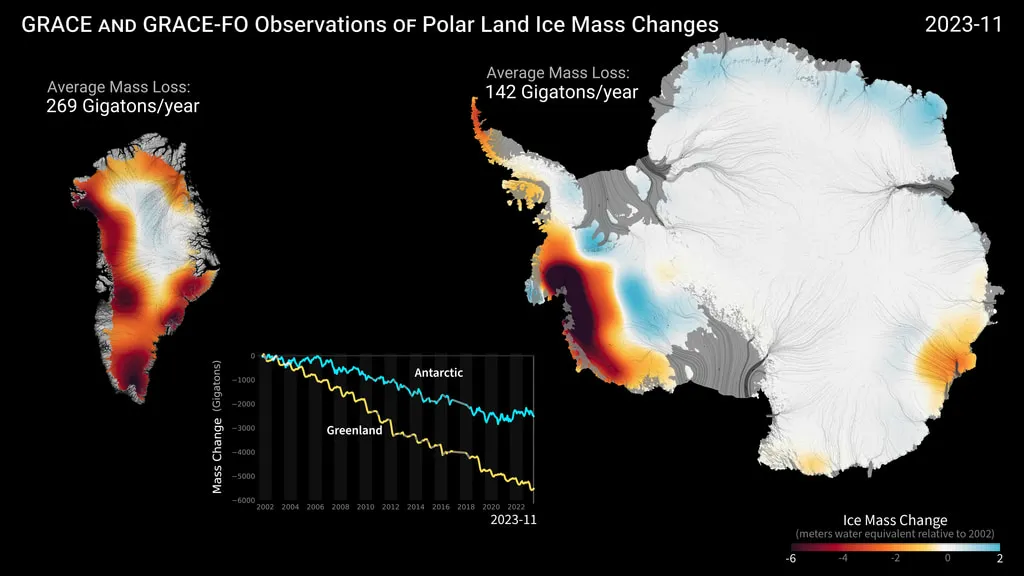
Source: National Snow and Ice Data Center — Why Ice Sheets Matter | National Snow and Ice Data Center · nsidc.org
Scientific Measurements & Evidence
GRACE satellites measure ice mass loss: Greenland loses ~280 billion tons/year, Antarctica ~150 billion tons/year
Gravitational effects: Massive ice loss changes regional gravity fields measurably
Post-glacial rebound: Land rises when ice weight is removed, affecting regional mass distribution
Eustatic sea level rise: Global average sea level rises ~3.3 mm/year partly due to ice melt
Trap: Ice melt affects both sea level rise AND rotational changes — not just one effect
Trap: Arctic sea ice melt doesn't raise sea level (already floating) but land ice does
Trap: Statement III correctly explained rotational axis shift, unlike Statement II
Trap: Don't confuse thermal expansion (water warming) with ice melt as causes of sea level rise
Conservation of Angular Momentum
Science And Technology
Conservation of Angular Momentum: The Physics Behind Earth's Rotation Changes
Angular momentum = mass × velocity × distance from rotation axis
When mass moves away from axis, rotation slows down to conserve momentum
Ice skater effect: arms out = slower spin, arms in = faster spin
Earth's rotation slows as polar ice becomes equatorial water
The Physics Principle
Conservation of angular momentum states that in a closed system, the total angular momentum remains constant. For Earth, this means when mass redistributes from poles (closer to rotation axis) to equator (farther from axis), the rotation speed must decrease to maintain the same total momentum.
Mass Position vs Rotational Speed
Mass Distribution | Distance from Axis | Effect on Rotation | Earth Example |
|---|---|---|---|
Concentrated at poles | Closer to axis | Faster rotation | Ice age periods |
Spread toward equator | Farther from axis | Slower rotation | Current ice melt |
Uniform distribution | Average distance | Steady rotation | Stable climate periods |
Ice Skater Analogy for Earth
%%{init: {"flowchart": {"wrappingWidth": 460}}}%%
flowchart TD
  s1["`**Ice skater spins with arms close**
Mass concentrated near rotation axis = fast spin`"]
  s2["`**Skater extends arms outward**
Mass moves farther from rotation axis`"]
  s3["`**Spinning slows down automatically**
Conservation of angular momentum reduces speed`"]
  s4["`**Earth: ice melts from poles**
Water redistributes from poles toward equator`"]
  s5["`**Earth's rotation slows slightly**
Day length increases by milliseconds per century`"]
  s1 --> s2
  s2 --> s3
  s3 --> s4
  s4 --> s5
Real-World Applications
Figure skaters use this principle to control spin speed during performances
Hurricanes intensify when rotating air masses contract toward the center
Pulsars (neutron stars) rotate incredibly fast because mass is extremely concentrated
Planetary rings form stable orbits based on conservation of angular momentum
Trap: Closer to axis = faster rotation, farther from axis = slower rotation
Trap: Angular momentum is conserved, but rotational speed can change when mass redistributes
Trap: The effect works for any mass redistribution, not just ice melt (earthquakes, dam construction, etc.)
Trap: This physics principle explains why Statement III correctly linked ice melt to rotational changes