In the context of electric vehicle batteries, consider the following elements: I. Cobalt II. Graphite III. Lithium IV. Nickel How many of the above usually make up battery cathodes?
Contents18
- AOnly one
- BOnly two
- COnly three
- DAll the four
Show answer
Answer: (C) Only three
To answer this, you need to know the basic structure of a lithium-ion battery.
It has three main parts:
- a cathode (positive electrode)
- an anode (negative electrode)
- and an electrolyte.
(I) Cobalt — Used in CATHODES.
It appears in popular cathode chemistries like LiCoO₂ (Lithium Cobalt Oxide), NMC (Nickel Manganese Cobalt), and NCA (Nickel Cobalt Aluminum).
Cobalt improves energy density and battery life. ✓ Cathode material.
(II) Graphite — Used in ANODES, not cathodes.
Graphite is the most common anode material in lithium-ion batteries.
During charging, lithium ions move from the cathode and get stored between graphite layers in the anode. ✗ This is anode material.
(III) Lithium — Used in CATHODES.
It forms the base compound of virtually all cathode materials — LiCoO₂, LiFePO₄, LiNiMnCoO₂, etc.
Lithium is also present in the electrolyte. ✓ Cathode material.
(IV) Nickel — Used in CATHODES.
It appears in NMC (Nickel Manganese Cobalt) and NCA (Nickel Cobalt Aluminum) cathodes.
Nickel enhances energy density and storage capacity. ✓ Cathode material.
So Cobalt, Lithium, and Nickel are cathode materials, while Graphite is an anode material.
Only three of the four make up cathodes.
Answer is (c).
Electric vehicle adoption in India accelerated significantly with policies like PLI schemes and FAME subsidies, making battery technology crucial for understanding the EV ecosystem.
UPSC is testing whether students understand the basic structure of lithium-ion batteries - distinguishing between cathode materials (cobalt, lithium, nickel) and anode materials (graphite).
The question requires knowing specific battery chemistry rather than just general EV knowledge - students must understand which elements go where in the actual battery structure.
Lithium-Ion Battery Structure
Science And Technology cathodes electric vehicle batteries
Lithium-Ion Battery Structure: Components & Materials
Lithium-ion battery has three main parts: cathode (positive), anode (negative), and electrolyte
Cathodes contain lithium, cobalt, nickel, and sometimes manganese
Anodes are typically made of graphite
During charging, lithium ions move from cathode to anode
Basic Components
A lithium-ion battery works through the movement of lithium ions between two electrodes. The cathode (positive electrode) releases lithium ions during discharge, while the anode (negative electrode) stores them. The electrolyte allows ion flow but blocks electron flow, forcing electrons through the external circuit to create useful electric current.
Battery Component Materials
Component | Common Materials | Function | UPSC Relevance |
|---|---|---|---|
Cathode | Lithium, Cobalt, Nickel, Manganese | Stores energy, determines capacity | Source of lithium ions |
Anode | Graphite, Silicon | Receives lithium ions when charging | Most common is graphite |
Electrolyte | Lithium salts in organic solvents | Conducts ions between electrodes | Enables battery operation |
Battery Structure
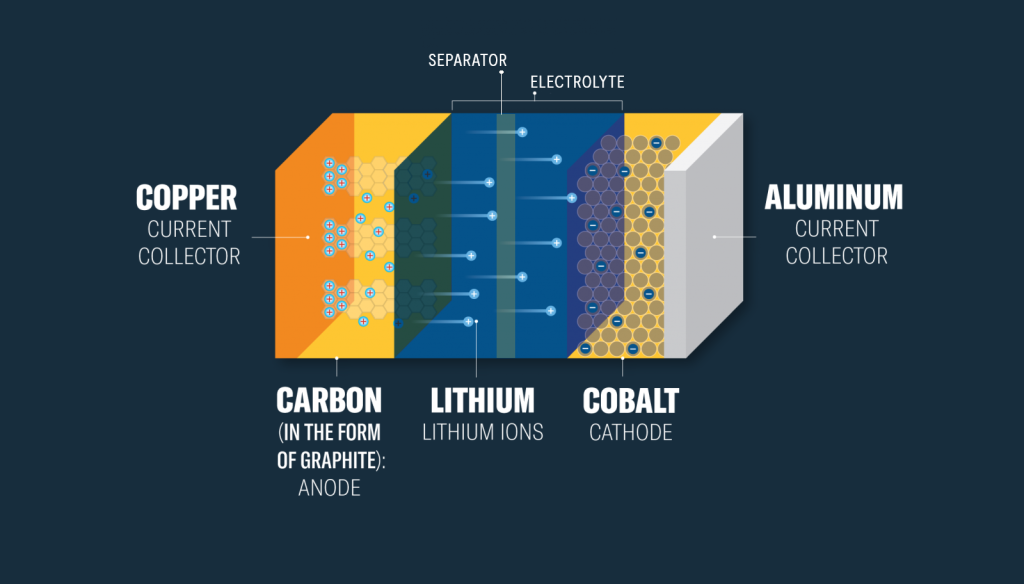
Source: Xplorlabs — Lithium-Ion Battery Cross-section - Xplorlabs · xplorlabs.org
Graphite is NOT a cathode material — it's the most common anode material
Don't confuse cathode (positive, where lithium compounds are) with anode (negative, typically graphite)
Lithium appears in both cathode compounds AND electrolyte, but the question asks about cathodes specifically
Cathode Materials & Chemistry
Science And Technology Cobalt Lithium Nickel
Cathode Materials: Lithium Compounds in EV Batteries
LiCoO₂ (Lithium Cobalt Oxide) — high energy density, used in phones/laptops
NMC (Nickel Manganese Cobalt) — balanced performance, common in EVs
All cathode materials contain lithium as the base element
LiFePO₄ (Lithium Iron Phosphate) — safer but lower energy density
Why These Elements
Cathode materials are lithium compounds that determine the battery's energy density, safety, and cost. Cobalt provides stability and high energy density but is expensive and ethically problematic. Nickel increases energy storage capacity. The trend is toward high-nickel, low-cobalt cathodes to reduce cost and improve performance.
Major Cathode Chemistries
Chemistry | Elements Used | Energy Density | Main Use | Key Advantage |
|---|---|---|---|---|
LiCoO₂ | Lithium + Cobalt | High | Phones, Laptops | Stable performance |
NMC | Lithium + Nickel + Manganese + Cobalt | High | EVs, Energy storage | Balanced properties |
NCA | Lithium + Nickel + Cobalt + Aluminum | Very High | Tesla vehicles | Maximum energy density |
LiFePO₄ | Lithium + Iron + Phosphate | Lower | Buses, Grid storage | Safety & long life |
Cathode Element Roles
# Cathode Materials
## Lithium
- Base element in all cathodes
- Provides lithium ions
- Li₂O, LiCoO₂, LiFePO₄
## Cobalt
- Structural stability
- High energy density
- Expensive & scarce
## Nickel
- Increases capacity
- Higher energy storage
- Can cause thermal issues
## Other Elements
- Manganese (stability)
- Iron (safety)
- Aluminum (structure)
Question Analysis
This question tests knowledge of battery electrode materials. Three elements (Cobalt, Lithium, Nickel) are used in cathodes, while Graphite is specifically an anode material where lithium ions get stored during charging.
Anode Materials & Graphite
Science And Technology Graphite
Anode Materials: Why Graphite Dominates
Graphite is the most common anode material in lithium-ion batteries
During charging, lithium ions move from cathode and get stored between graphite layers
Silicon anodes offer higher capacity but have expansion problems
Graphite Properties
Graphite has a layered crystal structure that allows lithium ions to slide between the carbon layers — a process called intercalation. This makes it ideal for reversible lithium storage. Graphite is also abundant, relatively cheap, and chemically stable.
Battery Charge Cycle
%%{init: {"flowchart": {"wrappingWidth": 460}}}%%
flowchart TD
  s1["`**Charging Starts**
External power applied to battery`"]
  s2["`**Lithium Ions Released**
Cathode releases Li⁺ ions into electrolyte`"]
  s3["`**Ion Migration**
Li⁺ ions move through electrolyte to anode`"]
  s4["`**Intercalation**
Li⁺ ions slip between **graphite layers** in anode`"]
  s5["`**Electron Flow**
Electrons flow through external circuit`"]
  s1 --> s2
  s2 --> s3
  s3 --> s4
  s4 --> s5
Anode Material Comparison
Material | Capacity | Advantages | Disadvantages | Current Use |
|---|---|---|---|---|
Graphite | 372 mAh/g | Stable, cheap, abundant | Lower capacity | Dominant in all EVs |
Silicon | 4200 mAh/g | 10x higher capacity | Expands 300%, breaks | Research stage |
Lithium Metal | 3860 mAh/g | Highest theoretical capacity | Safety issues, dendrites | Future technology |
Graphite is NOT used in cathodes — it's exclusively an anode material
Don't assume all four elements are cathode materials just because they're in batteries
Remember: cathode = lithium compounds, anode = usually graphite
EV Battery Trends & India
Science And Technology electric vehicle batteries
EV Battery Industry: Global Trends & Indian Initiatives
India imports 85% of lithium-ion batteries, mostly from China
PLI scheme offers ₹18,100 crore for battery manufacturing
Trend toward high-nickel, low-cobalt cathodes to reduce cost
India exploring lithium mining in Jammu & Kashmir
Global Battery Trends
The EV battery industry is moving toward nickel-rich cathodes (like NMC 811: 80% nickel, 10% manganese, 10% cobalt) to reduce dependence on expensive cobalt. LFP batteries (Lithium Iron Phosphate) are gaining popularity for their safety and lower cost, despite reduced range.
Indian EV Battery Initiatives
Initiative | Objective | Investment/Target | Status |
|---|---|---|---|
PLI for Battery Manufacturing | Domestic production | ₹18,100 crore over 5 years | Approved 2021 |
FAME II Scheme | EV adoption | ₹10,000 crore | Extended till 2024 |
National Battery Mission | End-to-end battery ecosystem | Under development | Planning stage |
Lithium Exploration (J&K) | Domestic lithium supply | 5.9 million tonnes reserves | Survey ongoing |
Strategic Challenges
Import dependence: China dominates lithium-ion battery supply chain from raw materials to finished cells
Critical mineral security: India lacks domestic sources of lithium, cobalt, and nickel
Technology gap: Indian companies focus on battery assembly, not cell manufacturing
Scale challenge: Global battery demand expected to grow 10x by 2030
Battery Supply Chain
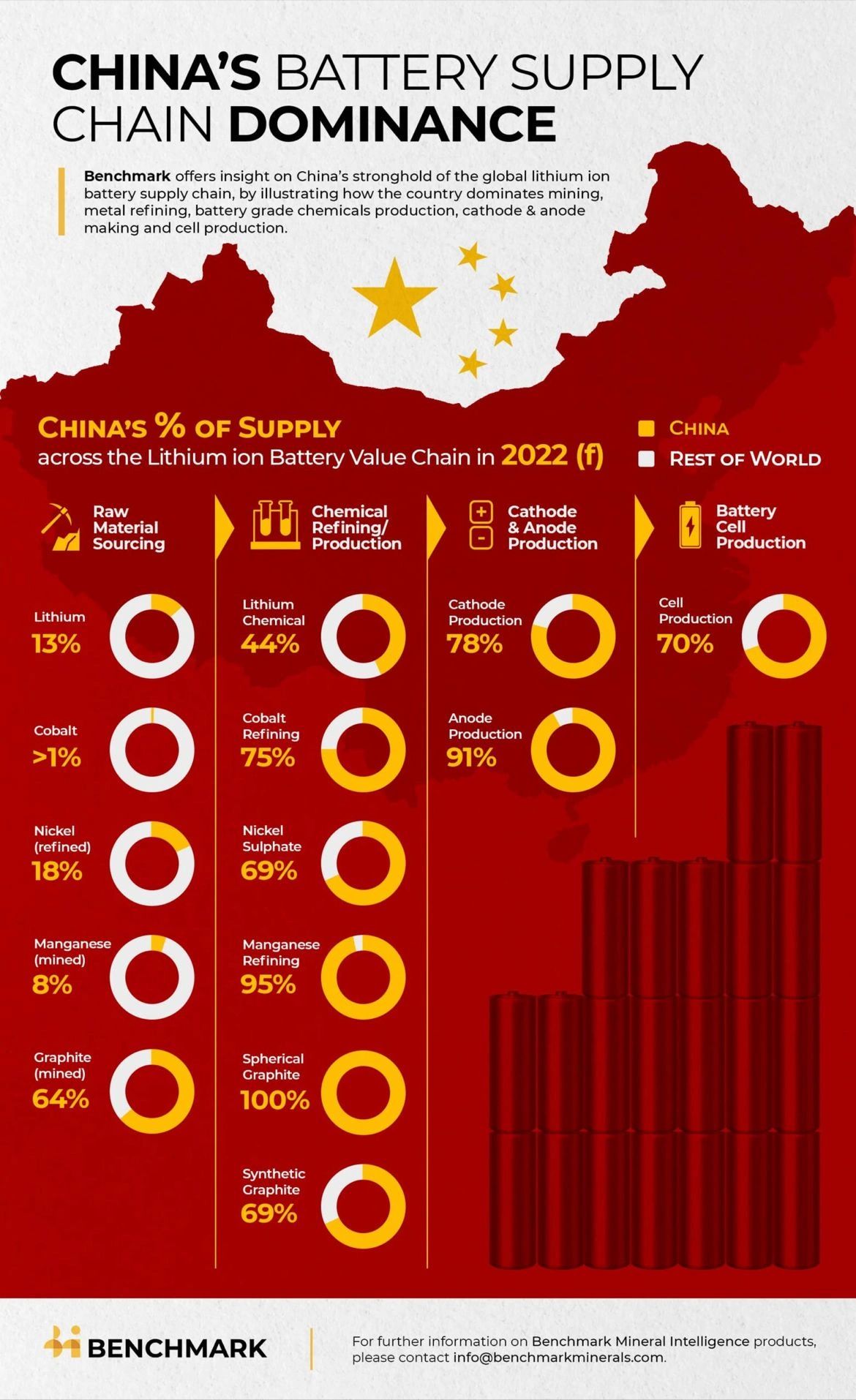
Source: Energsoft — Battery Supply Chains and Critical Materials · energsoft.com