Microbial fuel cells are considered a source of sustainable energy. Why? 1. They use living organisms as catalysts to generate electricity from certain substrates. 2. They use a variety of inorganic materials as substrates. 3. They can be installed in waste water treatment plants to cleanse water and produce electricity. Which of the statements given above is/are correct?
Contents19
- A1 only
- B2 and 3 only
- C1 and 3 only
- D1 and 2 and 3
Show answer
Answer: (C) 1 and 3 only
Statements 1 and 3 are correct.
Statement 2 is WRONG.
Statement 1 (✓):
Microbial fuel cells (MFCs) use LIVING MICROORGANISMS (bacteria) as biological catalysts.
These bacteria break down organic substrates (food waste, sewage) and, during this process, release electrons → generating electricity.
It's like bacteria 'eating' waste and producing electricity as a byproduct.
Statement 2 (✗):
MFCs primarily use ORGANIC (carbon-based) substrates, not inorganic materials.
The bacteria feed on organic matter — sugars, wastewater, sewage sludge.
Inorganic materials are not their primary fuel.
Statement 3 (✓):
MFCs are ideal for wastewater treatment plants because they serve a DUAL purpose:
the bacteria clean the dirty water (by consuming organic pollutants) AND generate electricity simultaneously.
It's a win-win: clean water + free electricity from waste.
Key concept:
MFCs = bacteria eat organic waste → produce electricity + clean water.
Microbial fuel cells generate electricity by using bacteria to break down organic waste, making them valuable for both energy production and waste management.
The trap is statement 2 - MFCs use organic substrates like sewage and food waste, not inorganic materials, because bacteria feed on carbon-based matter.
UPSC is testing whether students understand the dual benefit concept - that sustainable technologies often solve multiple problems simultaneously rather than just producing energy.
Microbial Fuel Cells (MFC)
Science And Technology Microbial fuel cells living organisms catalysts electricity
Microbial Fuel Cells: Bacteria-Powered Electricity Generation
Quick Facts
MFCs use living bacteria as biological catalysts to convert organic waste into electricity
Bacteria consume organic substrates (sewage, food waste) — NOT inorganic materials
Dual benefit: waste treatment + electricity generation in wastewater plants
Considered sustainable energy because it uses waste as fuel and produces clean water
Working Principle
Microbial Fuel Cells (MFCs) are bioelectrochemical devices that harness bacteria to generate electricity from organic waste. The core mechanism involves bacteria breaking down organic matter and releasing electrons in the process — these electrons flow through an external circuit, creating electrical current.
How MFCs Generate Electricity
%%{init: {"flowchart": {"wrappingWidth": 460}}}%%
flowchart TD
  s1["`**Organic Substrate Input**
Bacteria receive organic matter (sewage, food waste, glucose)`"]
  s2["`**Bacterial Metabolism**
Bacteria break down organic compounds in anaerobic conditions`"]
  s3["`**Electron Release**
Metabolic process releases electrons and protons`"]
  s4["`**Electrical Current**
Electrons flow through external circuit to cathode, generating electricity`"]
  s5["`**Water Production**
At cathode: electrons + protons + oxygen → clean water`"]
  s1 --> s2
  s2 --> s3
  s3 --> s4
  s4 --> s5
Substrate Requirements
Material Type | Examples | Suitability for MFC | Reason |
|---|---|---|---|
Organic (carbon-based) | Sewage, food waste, glucose, acetate | ✓ Primary fuel | Bacteria can metabolize these compounds |
Inorganic (mineral-based) | Metals, salts, rocks | ✗ Not suitable | Bacteria cannot break down for energy |
Applications & Benefits
Wastewater treatment plants: Remove organic pollutants while generating electricity
Remote power generation: Provide electricity in areas without grid access using local organic waste
Biosensors: Detect presence of specific organic compounds in water
Carbon-neutral energy: No net CO₂ emissions since organic waste would decompose anyway
Resource recovery: Convert waste streams into valuable energy output
MFC Structure
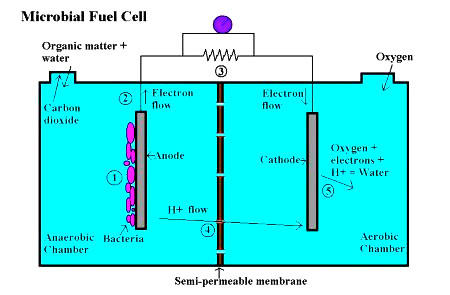
Source: USC Viterbi School of Engineering — Microbial Fuel Cells: Generating Power from Waste - USC ... · illumin.usc.edu
Question Connection
This UPSC question tested understanding of MFC substrates and applications. The trap in Statement 2 was suggesting MFCs use inorganic materials — but bacteria require organic carbon-based compounds for metabolism. Statement 3 correctly identifies the dual benefit of waste treatment + electricity generation.
Trap: Confusing organic vs inorganic substrates — MFCs need organic (carbon-based) materials, not inorganic minerals
Trap: Thinking MFCs are purely electricity devices — they also treat wastewater by removing organic pollutants
Trap: Assuming any living organism works — MFCs specifically use bacteria, not all microorganisms
Trap: Missing the sustainability angle — MFCs are sustainable because they use waste as fuel and produce clean water
Sustainable Energy Technologies
Science And Technology sustainable energy
Sustainable Energy: Technologies Converting Waste to Power
Key Characteristics
Sustainable energy uses renewable resources or waste materials as fuel source
Technologies provide dual benefits: waste management + energy generation
Carbon-neutral or negative: no net increase in atmospheric CO₂
Waste-to-Energy Technologies
Technology | Waste Input | Energy Output | Additional Benefit |
|---|---|---|---|
Microbial Fuel Cells | Organic waste, sewage | Electricity | Water treatment |
Biogas Plants | Animal dung, crop residues | Methane gas | Organic fertilizer (slurry) |
Waste Incineration | Municipal solid waste | Electricity + heat | Volume reduction (90%) |
Biomass Gasification | Agricultural residues | Syngas → electricity | Reduced air pollution from burning |
Anaerobic Digestion | Food waste, sewage sludge | Biogas | Pathogen reduction |
Why These Are Sustainable
Waste utilization: Convert waste streams into energy instead of landfilling
Renewable feedstock: Organic waste is continuously generated by human activities
Pollution reduction: Prevent methane emissions from decomposing waste
Resource efficiency: Extract energy value from materials before disposal
Circular economy: Close the loop between waste generation and energy needs
Sustainable Energy Categories
# Sustainable Energy
## **Natural Renewables**
- Solar
- Wind
- Hydroelectric
- Geothermal
## **Biomass & Bioenergy**
- Biogas
- Ethanol
- Biodiesel
- Wood pellets
## **Waste-to-Energy**
- MFC
- Incineration
- Gasification
- Anaerobic digestion
## **Emerging Tech**
- Tidal
- Wave
- Hydrogen fuel cells
- Algae biofuels
Wastewater Treatment & Energy Integration
Environment waste water treatment plants
Energy Recovery in Wastewater Treatment Plants
Integration Benefits
Dual function: Clean polluted water while generating renewable energy from organic waste
Energy self-sufficiency: Treatment plants can meet 50-100% of their electricity needs
Cost reduction: Lower operational costs through on-site energy generation
Integration Logic
Wastewater treatment plants are ideal locations for energy recovery technologies because they process large volumes of organic-rich waste daily. Instead of just removing pollutants, modern plants extract energy value from this waste while achieving the same cleaning objectives.
Energy Technologies in Treatment Plants
Technology | Installation Point | Energy Source | Electricity Output | Treatment Benefit |
|---|---|---|---|---|
Microbial Fuel Cells | Primary/Secondary treatment | Organic pollutants | Low voltage DC | BOD/COD reduction |
Anaerobic Digesters | Sludge processing | Sewage sludge | Biogas → electricity | Sludge volume reduction |
Biogas Capture | Anaerobic ponds | Organic matter decomposition | Methane → electricity | Odor control |
Solar Panels | Roof/open areas | Sunlight | AC electricity | Grid independence |
Small Hydro | Outfall channels | Treated water flow | Mechanical → electrical | Flow energy recovery |
Integrated Treatment Process
%%{init: {"flowchart": {"wrappingWidth": 460}}}%%
flowchart TD
  s1["`**Raw Wastewater Input**
Sewage containing organic pollutants enters treatment plant`"]
  s2["`**Primary Treatment + Energy**
Physical separation + MFC electricity generation from organics`"]
  s3["`**Secondary Treatment + Energy**
Biological treatment + biogas capture from bacterial activity`"]
  s4["`**Sludge Processing + Energy**
Anaerobic digestion of sludge → biogas → electricity`"]
  s5["`**Clean Water Discharge**
Treated water meets discharge standards, plant powered by own waste`"]
  s1 --> s2
  s2 --> s3
  s3 --> s4
  s4 --> s5
Implementation Advantages
Consistent feedstock: Wastewater generation is steady and predictable
Existing infrastructure: Can retrofit energy systems into current plants
Regulatory alignment: Meets both pollution control and renewable energy targets
Public acceptance: Converts waste problem into energy solution
Scalability: Works for both municipal and industrial treatment facilities