Mycorrhizal biotechnology has been used in rehabilitating degraded sites because mycorrhiza enables the plants to 1. Resist drought and increase absorptive area 2. Tolerate extremes of pH 3. Resist disease infestation Select the correct answer using the codes given below:
Contents18
- A1 only
- B2 and 3 only
- C1 and 3 only
- D1, 2 and 3
Show answer
Answer: (D) 1, 2 and 3
All three statements are correct.
Mycorrhiza is a symbiotic association between fungi and plant roots, and it provides multiple benefits:
Statement 1 — Mycorrhizal fungi extend their hyphae (thread-like structures) far beyond the root zone, dramatically increasing the absorptive area for water and nutrients. This helps plants resist drought because they can access water from a much larger soil volume.
Statement 2 — Re-introduction of mycorrhizal fungi into degraded soils helps plants tolerate extremes of pH. The fungi can access mineral and organic nutrient sources (like phosphorus) that are otherwise unavailable in acidic soils (pH < 5), helping plants overcome nutrient limitations.
Statement 3 — Vesicular-arbuscular mycorrhizae (VAM) enhance plant disease resistance through multiple mechanisms:
- exclusion of the pathogen
- strengthening of plant cell walls (lignification)
- improved nutrition
- formation of inhibitory compounds.
VAM-positive plants show varied resistance towards soil-borne and foliar pathogens.
Mycorrhiza is a symbiotic fungus-root association that increases water and nutrient absorption by extending fungal networks far beyond root zones.
Degraded land rehabilitation became a priority topic around 2010-2013 due to increasing soil degradation and the need for sustainable restoration techniques.
The question tests understanding of how biological solutions work at the cellular level - fungal hyphae extending absorption area, pH tolerance mechanisms, and pathogen resistance pathways.
Mycorrhizal Symbiosis
Science And Technology mycorrhiza symbiotic association
Mycorrhizal Symbiosis: Plant-Fungi Partnership & Benefits
Mycorrhiza = symbiotic association between fungi and plant roots
Fungal hyphae extend beyond root zone, increasing absorptive area
Enables plants to tolerate drought, pH extremes, and diseases
Key technology for rehabilitating degraded sites
What is Mycorrhiza
Mycorrhiza is a mutually beneficial partnership between fungi and plant roots. The fungi get carbohydrates from the plant, while the plant gains access to water and nutrients through the fungi's extensive network.
Types of Mycorrhiza
Type | Location | Key Features | Plant Partners |
|---|---|---|---|
Ectomycorrhiza | Around root surface | Forms fungal sheath | Trees (pine, oak) |
Endomycorrhiza (VAM) | Inside root cells | Forms arbuscules and vesicles | Most crop plants |
Ericoid | In root cortex | Dense hyphal coils | Heather family plants |
Mycorrhizal Structure
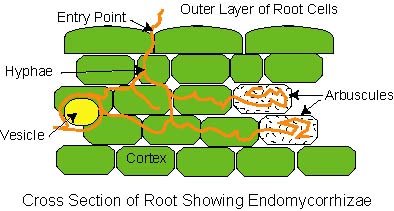
Source: www2.nau.edu — Mycorrhizae · www2.nau.edu
Drought Resistance Mechanism
Science And Technology drought absorptive area
How Mycorrhiza Enables Drought Resistance
Fungal hyphae are thinner than roots, reach more soil spaces
Absorptive area increases by 100-1000 times
Access water from larger soil volume during dry periods
Drought Resistance Process
%%{init: {"flowchart": {"wrappingWidth": 460}}}%%
flowchart TD
  s1["`**Fungal Network Formation**
**Hyphae** spread far beyond root zone into soil`"]
  s2["`**Increased Surface Area**
Absorptive area multiplies by **100-1000x**`"]
  s3["`**Enhanced Water Access**
Fungi tap water from distant soil particles`"]
  s4["`**Drought Tolerance**
Plant survives dry conditions with mycorrhizal support`"]
  s1 --> s2
  s2 --> s3
  s3 --> s4
Why This Works
Plant roots are thick and can only access water in their immediate vicinity. Fungal hyphae are much thinner (2-5 micrometers) and can penetrate tiny soil spaces that roots cannot reach, creating a vast water collection network.
pH Tolerance Mechanism
Science And Technology pH extremes
Mycorrhizal pH Tolerance & Nutrient Access
Fungi access phosphorus locked in acidic soils (pH < 5)
Convert unavailable nutrients into plant-usable forms
Critical for rehabilitating degraded acidic sites
The pH Problem
In acidic soils (pH < 5), essential nutrients like phosphorus get locked up in forms plants cannot absorb. In alkaline soils (pH > 8), iron and other micronutrients become unavailable.
How Mycorrhiza Solves This
Fungal enzymes solubilize bound phosphorus in acidic conditions
Fungi produce organic acids that release locked nutrients
Hyphal network explores soil zones with better nutrient availability
Fungi store nutrients and release them gradually to plants
Soil pH & Nutrient Problems
Soil Condition | pH Range | Locked Nutrients | Mycorrhizal Solution |
|---|---|---|---|
Acidic | < 5.0 | Phosphorus, Calcium | Enzyme solubilization |
Neutral | 6.0-7.5 | Optimal availability | Enhanced uptake |
Alkaline | > 8.0 | Iron, Zinc, Manganese | Chelation & mobilization |
Disease Resistance Mechanism
Science And Technology disease infestation resist
Mycorrhizal Disease Resistance & Plant Protection
VAM (Vesicular-Arbuscular Mycorrhiza) enhances disease resistance
Multiple mechanisms: exclusion, cell wall strengthening, nutrition
Effective against soil-borne and foliar pathogens
Disease Resistance Mechanisms
# Mycorrhizal Disease Protection
## Physical Barriers
- Pathogen exclusion
- Root colonization space
- Hyphal barriers
## Plant Strengthening
- Cell wall lignification
- Structural reinforcement
- Root architecture
## Chemical Defense
- Inhibitory compounds
- Antifungal metabolites
- Enzyme production
## Nutritional Boost
- Better P uptake
- Enhanced immunity
- Stress tolerance
VAM Protection
Vesicular-Arbuscular Mycorrhizae (VAM) create a biological shield around roots. The beneficial fungi occupy root space that harmful pathogens would otherwise colonize, while simultaneously boosting plant health through better nutrition.
Degraded Site Rehabilitation
Environment rehabilitating degraded sites
Mycorrhizal Biotechnology in Site Rehabilitation
Mycorrhizal inoculation restores degraded soils
Enables plant survival in mining sites, polluted areas
Faster ecosystem recovery compared to natural succession
Why Degraded Sites Need Help
Degraded sites like mining areas, industrial zones, or eroded lands lack soil biology. Without mycorrhizal fungi, plants struggle to establish because they cannot access limited nutrients or survive harsh conditions.
Rehabilitation Applications
Site Type | Key Problem | Mycorrhizal Solution | Result |
|---|---|---|---|
Mining sites | Acidic soil, heavy metals | Metal tolerance + pH buffering | Successful revegetation |
Eroded lands | Nutrient depletion | Enhanced nutrient uptake | Soil rebuilding |
Salt-affected areas | Salinity stress | Osmotic regulation | Salt-tolerant vegetation |
Industrial zones | Contaminated soil | Pollutant tolerance | Phytoremediation support |
Rehabilitation Process
%%{init: {"flowchart": {"wrappingWidth": 460}}}%%
flowchart TD
  s1["`**Site Assessment**
Analyze soil pH, nutrients, contamination levels`"]
  s2["`**Mycorrhizal Inoculation**
Introduce suitable **VAM or ectomycorrhizal** species`"]
  s3["`**Plant Establishment**
Sow seeds or transplant seedlings with fungal partners`"]
  s4["`**Ecosystem Recovery**
Plants thrive, soil biology returns, natural succession begins`"]
  s1 --> s2
  s2 --> s3
s3 --> s4All three benefits (drought resistance, pH tolerance, disease resistance) are correct — UPSC tests comprehensive understanding
Don't confuse mycorrhiza (fungi-plant) with rhizobia (bacteria-legume nitrogen fixation)
VAM stands for Vesicular-Arbuscular Mycorrhizae, not Virus-Associated Microbes