Consider the following animals: 1. Sea cow 2. Sea horse 3. Sea lion Which of the above is/are mammal/mammals?
Contents15
- A1 only
- B1 and 3 only
- C2 and 3 only
- D1, 2 and 3
Show answer
Answer: (B) 1 and 3 only
Don't be misled by the names — not all 'sea' animals are the same type!
Mammals are characterized by:
- warm blood
- hair/fur
- breathing air through lungs
- giving birth to live young
- feeding young with milk.
Sea cow (1) — MAMMAL.
Also called Dugong (Dugong dugon).
It is a large aquatic herbivorous mammal found in shallow coastal waters.
In India, it is found in the Gulf of Mannar and Andaman & Nicobar Islands.
It breathes air, gives birth to live young, and nurses them with milk.
Sea horse (2) — NOT a mammal.
Despite its unusual appearance, a sea horse is a bony fish (genus Hippocampus).
It breathes through gills, is cold-blooded, and lays eggs.
It belongs to the class Actinopterygii (ray-finned fishes).
Sea lion (3) — MAMMAL.
Sea lions are warm-blooded, give birth to live young on land, produce milk, and have hair.
They belong to the family Otariidae.
So only 1 and 3 are mammals.
Sea cows (dugongs) are critically endangered marine mammals found only in Gulf of Mannar and Andaman & Nicobar Islands in India, making their conservation status highly relevant for environment questions.
The question tests classification skills by using misleading names - seahorses are actually fish despite the name, while sea cows and sea lions are true mammals.
Students must know the defining characteristics of mammals (warm-blooded, live birth, milk production, breathing air) versus fish (gills, cold-blooded, eggs) to avoid name-based confusion.
Marine Mammals
Environment Sea cow Sea lion mammal
Marine Mammals: Classification & Key Species
Sea cow (Dugong) and Sea lion are mammals; Sea horse is a fish
Marine mammals breathe air, are warm-blooded, give live birth, and produce milk
Dugongs are found in Gulf of Mannar and Andaman & Nicobar Islands in India
What Makes Marine Mammals Special
Marine mammals are air-breathing vertebrates that live in water but retain all mammalian characteristics. Unlike fish, they must surface to breathe and give birth to live young that nurse on milk.
Marine vs Non-Marine Animals
Animal | Type | Breathing | Body Temperature | Reproduction | Classification |
|---|---|---|---|---|---|
Sea Cow (Dugong) | Mammal | Lungs (air) | Warm-blooded | Live birth + milk | Order Sirenia |
Sea Lion | Mammal | Lungs (air) | Warm-blooded | Live birth + milk | Family Otariidae |
Sea Horse | Fish | Gills (water) | Cold-blooded | Lays eggs | Genus Hippocampus |
Sea Cow (Dugong) Facts
Dugong dugon - large herbivorous marine mammal, grazes on seagrass beds
Found in shallow coastal waters of Indian Ocean and western Pacific
In India: Gulf of Mannar Marine National Park and Andaman & Nicobar Islands
Vulnerable species - protected under Wildlife Protection Act Schedule I
Can grow up to 3 meters and weigh 400 kg
Trap: Sea horse sounds like a mammal but is actually a bony fish with gills
Trap: Don't assume all 'sea' animals are the same type - classify by biological characteristics
Trap: Dugong vs Manatee - Dugongs have forked tails, Manatees have paddle-shaped tails
Trap: Sea cow is the common name for Dugong - both refer to the same animal
Mammalian Characteristics
Environment mammal warm blood milk
Mammalian Characteristics: Defining Features
Five key traits: warm-blooded, hair/fur, air breathing, live birth, milk production
Class Mammalia - most diverse vertebrate class with ~5,400 species
Includes terrestrial, aquatic, and aerial species
Mammal vs Other Vertebrates
Feature | Mammals | Birds | Reptiles | Amphibians | Fish |
|---|---|---|---|---|---|
Body Temperature | Warm-blooded | Warm-blooded | Cold-blooded | Cold-blooded | Cold-blooded |
Breathing | Lungs | Lungs | Lungs | Lungs + Skin | Gills |
Body Covering | Hair/Fur | Feathers | Scales | Moist skin | Scales |
Reproduction | Live birth* | Eggs | Eggs* | Eggs | Eggs* |
Young Feeding | Milk | Regurgitation | Independent | Independent | Independent |
Types of Mammals
# Class Mammalia
## Terrestrial
- Primates
- Carnivores
- Ungulates
- Rodents
## Aquatic
- Whales
- Dolphins
- Seals
- Dugongs
## Aerial
- Bats (only flying mammals)
## By Reproduction
- Placental (most)
- Marsupials
- Monotremes (egg-laying)Trap: Platypus and Echidna are mammals that lay eggs (monotremes)
Trap: Bats are the only mammals capable of true sustained flight
Trap: Dolphins and Whales are mammals, not fish - they breathe air and produce milk
Trap: Some mammals like seals give birth on land even though they live in water
Sea Horse Classification
Environment Sea horse fish
Sea Horse: Unique Fish, Not Mammal
Sea horse belongs to genus Hippocampus - it's a bony fish, not mammal
Male sea horses carry and give birth to young - unique in animal kingdom
Breathes through gills and is cold-blooded like all fish
Why Sea Horse Confuses Students
Despite its name and unusual appearance, sea horse is definitely a fish. It has gills for breathing underwater, fins for movement, and cold-blooded metabolism - all fish characteristics.
Sea Horse Unique Features
Male pregnancy - males carry fertilized eggs in brood pouch and give birth
Prehensile tail - can grasp objects like monkey tails
Independent eye movement - each eye can look in different directions
No stomach - food passes through digestive system quickly
Bony plates instead of scales - provide armor-like protection
Sea Horse vs Typical Fish
Feature | Sea Horse | Typical Fish | Significance |
|---|---|---|---|
Body Shape | Vertical, horse-like head | Streamlined | Adapted for hiding in vegetation |
Swimming | Dorsal fin propulsion | Body + tail movement | Slow swimmers, rely on camouflage |
Reproduction | Male carries eggs | Female carries eggs | Unique role reversal |
Feeding | Suction feeding | Various methods | No teeth, swallow prey whole |
Trap: Don't be fooled by the 'horse' in sea horse - it's still a fish with gills
Trap: Male sea horses give birth but this doesn't make them mammals
Trap: Sea horses are poor swimmers - they anchor to coral reefs and seagrass beds
Indian Marine Biodiversity
Environment Gulf of Mannar Andaman & Nicobar Islands
India's Marine Biodiversity Hotspots
Gulf of Mannar Marine National Park - first marine national park in India
Dugongs found only in Gulf of Mannar and Andaman & Nicobar Islands in India
India has 7,500+ km coastline with diverse marine ecosystems
India's Marine Protected Areas
India's marine biodiversity is concentrated in coral reef ecosystems, mangrove forests, and seagrass beds. These support endangered species like Dugongs, Sea turtles, and diverse fish populations.
Key Marine Protected Areas
Protected Area | Location | Established | Key Species | Ecosystem Type |
|---|---|---|---|---|
Gulf of Mannar Marine National Park | Tamil Nadu | 1986 | Dugong, Sea turtle, Coral | 21 islands + coral reefs |
Mahatma Gandhi Marine National Park | Andaman & Nicobar | 1983 | Dugong, Sea turtle, Coral | 15 islands + mangroves |
Sundarbans National Park | West Bengal | 1984 | Saltwater crocodile | Mangrove delta |
Marine National Park | Gujarat (Jamnagar) | 1982 | Coral, Dolphin | 42 islands in Gulf of Kutch |
Dugong Distribution in India
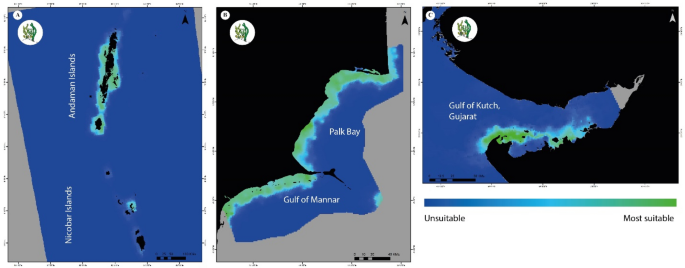
Source: Nature — Spatial prioritization of dugong habitats in India can contribute ... · www.nature.com
Trap: Gulf of Mannar is between India and Sri Lanka, not in Arabian Sea
Trap: India's first marine national park was Gulf of Mannar (1986), not Sundarbans
Trap: Dugongs are found in only 2 locations in India - don't include Kerala or Odisha coasts