Which of the following adds/add nitrogen to the soil? 1. Excretion of urea by animals 2. Burning of coal by man 3. Death of vegetation Select the correct answer using the codes given below:
Contents18
- A1 only
- B2 and 3 only
- C1 and 3 only
- D1, 2 and 3
Show answer
Answer: (C) 1 and 3 only
Statement 1 is correct — when animals excrete urea, it enters the soil.
Soil organisms (worms, insects, beetles, ants, and eventually bacteria and fungi) break down this waste material into simpler nitrogen compounds that plants can absorb.
This is a key part of the nitrogen cycle — nitrogen returns from animals to soil.
Statement 3 is correct — when vegetation dies, the dead plant matter is decomposed by microorganisms (bacteria and fungi).
The nitrogen stored in plant tissues is broken down and released back into the soil as ammonium and nitrates, which become available for new plant growth.
Statement 2 is wrong — burning coal releases nitrogen compounds into the ATMOSPHERE (as nitrogen oxides — NOₓ), not into the soil.
These atmospheric nitrogen oxides contribute to air pollution and acid rain, but they do not directly add nitrogen to the soil in a beneficial way.
So statements 1 and 3 are correct.
The nitrogen cycle is fundamental to soil fertility and agricultural productivity, as nitrogen is the most limiting nutrient for plant growth in most ecosystems.
UPSC is testing whether students can distinguish between nitrogen additions to soil versus atmosphere - burning coal releases nitrogen oxides to air, not soil.
The question tests understanding of biological versus industrial nitrogen processes in the environment.
Nitrogen Cycle & Soil Nitrogen
Environment nitrogen soil urea vegetation coal
Nitrogen Cycle: How Nitrogen Reaches & Leaves Soil
Nitrogen cycle moves nitrogen between atmosphere, soil, plants, and animals
Animal waste and dead vegetation add nitrogen to soil through decomposition
Coal burning releases nitrogen to atmosphere as NOₓ, not to soil
Soil microorganisms convert organic nitrogen into ammonium and nitrates
Why This Matters
The nitrogen cycle is essential for all life because nitrogen is needed for proteins and DNA. Plants cannot use atmospheric nitrogen directly — they need it in specific forms like nitrates and ammonium that exist in soil.
How Nitrogen Enters Soil
%%{init: {"flowchart": {"wrappingWidth": 460}}}%%
flowchart TD
  s1["`**Animal Waste & Dead Plants**
**Urea from animals** and **dead vegetation** contain organic nitrogen compounds`"]
  s2["`**Decomposition**
**Bacteria and fungi** break down organic matter in soil`"]
  s3["`**Mineralization**
Organic nitrogen converts to **ammonium (NH₄⁺)** first`"]
  s4["`**Nitrification**
Soil bacteria convert ammonium to **nitrates (NO₃⁻)**`"]
  s5["`**Plant Uptake**
Plants absorb nitrates and ammonium through roots`"]
  s1 --> s2
  s2 --> s3
  s3 --> s4
  s4 --> s5
Sources: Soil vs Atmosphere
Source | Where Nitrogen Goes | Form Released | Benefit to Plants |
|---|---|---|---|
Animal urea | Soil | Ammonium → Nitrates | Direct soil enrichment |
Dead vegetation | Soil | Organic nitrogen → Nitrates | Returns stored nitrogen to soil |
Coal burning | Atmosphere | NOₓ gases | No direct benefit; causes air pollution |
Lightning | Soil via rain | Nitrates | Natural nitrogen fixation |
Fertilizers | Soil | Urea, ammonium, nitrates | Artificial soil enrichment |
Question Connection
This UPSC question tested whether students know that coal burning adds nitrogen to the atmosphere, not soil. The trap was assuming all nitrogen release helps soil — but NOₓ from coal becomes air pollution, not plant nutrition.
Trap: Thinking coal burning helps soil because it releases nitrogen — it goes to atmosphere as NOₓ
Confusion: All organic matter adds nitrogen to soil — but burning sends it to air, decomposition sends it to soil
Memory aid: Decomposition = Soil gain, Combustion = Air pollution
Animal Waste & Soil Enrichment
Environment urea animals excretion
How Animal Waste Enriches Soil Nitrogen
Urea from animal excretion is the main nitrogenous waste that enriches soil
Soil organisms convert urea into ammonium, then bacteria make nitrates
This process is called mineralization followed by nitrification
The Process
When animals excrete urea (CO(NH₂)₂), it doesn't immediately help plants. Soil organisms like earthworms, beetles, and ants first break down the waste. Then bacteria and fungi complete the decomposition process.
Why Animal Waste Works
High nitrogen content: Urea is 46% nitrogen by weight — very concentrated
Slow release: Decomposition gives steady nitrogen supply, not sudden burst
Microbial activity: Animal waste feeds soil bacteria, improving overall soil health
Organic matter: Adds carbon along with nitrogen, improving soil structure
Natural process: Part of ecosystem's natural nutrient recycling
Types of Animal Waste
Animal | Waste Type | Nitrogen Content | Decomposition Time |
|---|---|---|---|
Cattle | Dung + urine | High in urea | 2-6 months |
Poultry | Droppings | Very high nitrogen | 1-3 months |
Sheep/Goat | Pellets | Medium nitrogen | 3-6 months |
Earthworms | Castings | Processed organic nitrogen | Immediate availability |
Don't confuse: Fresh urea vs decomposed urea — plants need the decomposed form
Remember: Animal waste needs soil microorganisms to become plant-available nitrogen
Dead Vegetation & Nitrogen Release
Environment death of vegetation vegetation
How Dead Plants Return Nitrogen to Soil
Dead vegetation releases stored nitrogen back to soil through decomposition
Bacteria and fungi break down plant proteins into soil-available nitrogen forms
This creates a continuous nitrogen cycle in natural ecosystems
Why Dead Plants Help
Living plants store large amounts of nitrogen in their proteins, chlorophyll, and DNA. When plants die, this nitrogen doesn't disappear — decomposer organisms break down the plant tissues and release the nitrogen back to soil.
Plant Death → Soil Nitrogen
%%{init: {"flowchart": {"wrappingWidth": 460}}}%%
flowchart TD
  s1["`**Plant Dies**
Leaves, stems, roots contain **proteins and nucleic acids** with nitrogen`"]
  s2["`**Physical Breakdown**
**Earthworms, insects, beetles** fragment the dead plant matter`"]
  s3["`**Microbial Decomposition**
**Bacteria and fungi** break down complex organic nitrogen compounds`"]
  s4["`**Mineralization**
Organic nitrogen becomes **ammonium (NH₄⁺)** in soil`"]
  s5["`**Nitrification**
Soil bacteria convert ammonium to **nitrates (NO₃⁻)** for new plants`"]
  s1 --> s2
  s2 --> s3
  s3 --> s4
  s4 --> s5
Examples in Nature
Leaf litter: Autumn leaves decompose over winter, releasing nitrogen for spring growth
Forest floors: Constant decomposition of dead branches, leaves creates nitrogen-rich soil
Crop residues: Leftover rice stalks, wheat stubble add nitrogen when plowed into soil
Grass clippings: Dead grass returns nitrogen to soil in natural grasslands
Algae: Dead algae in water bodies release nitrogen back to aquatic ecosystems
Key point: Dead vegetation returns nitrogen that the plant originally took from soil — it's recycling
Don't think: Dead plants create new nitrogen — they just release stored nitrogen back to soil
Coal Burning & Atmospheric Nitrogen
Environment burning of coal coal
Why Coal Burning Doesn't Add Nitrogen to Soil
Coal burning releases NOₓ gases to atmosphere, not nitrogen to soil
NOₓ from coal causes air pollution and acid rain, harming soil
This was the trap option in the UPSC question — confusing atmospheric vs soil nitrogen
What Actually Happens
Coal contains nitrogen compounds that burn at high temperatures in thermal power plants. This combustion releases nitrogen oxides (NOₓ) — mainly NO and NO₂ — directly into the atmosphere as gaseous pollutants.
Coal vs Beneficial Nitrogen Sources
Source | Nitrogen Goes To | Form Released | Effect on Soil | Effect on Plants |
|---|---|---|---|---|
Coal burning | Atmosphere | NO, NO₂ gases | Acid rain damages soil | Harmful air pollution |
Animal waste | Soil directly | Organic compounds → NH₄⁺ | Enriches soil | Provides nutrition |
Dead plants | Soil directly | Proteins → NH₄⁺ → NO₃⁻ | Natural recycling | Returns stored nutrients |
Lightning | Soil via rainwater | Nitrates in rain | Natural fertilization | Beneficial nitrogen input |
Problems from Coal NOₓ
Air pollution: NOₓ causes smog, respiratory problems, ozone depletion
Acid rain: NOₓ + water vapor forms nitric acid, making rain acidic
Soil acidification: Acid rain lowers soil pH, reducing fertility
Plant damage: Acidic conditions harm plant roots and nutrient uptake
Water pollution: NOₓ runoff causes eutrophication in water bodies
Coal Power Plant Emissions
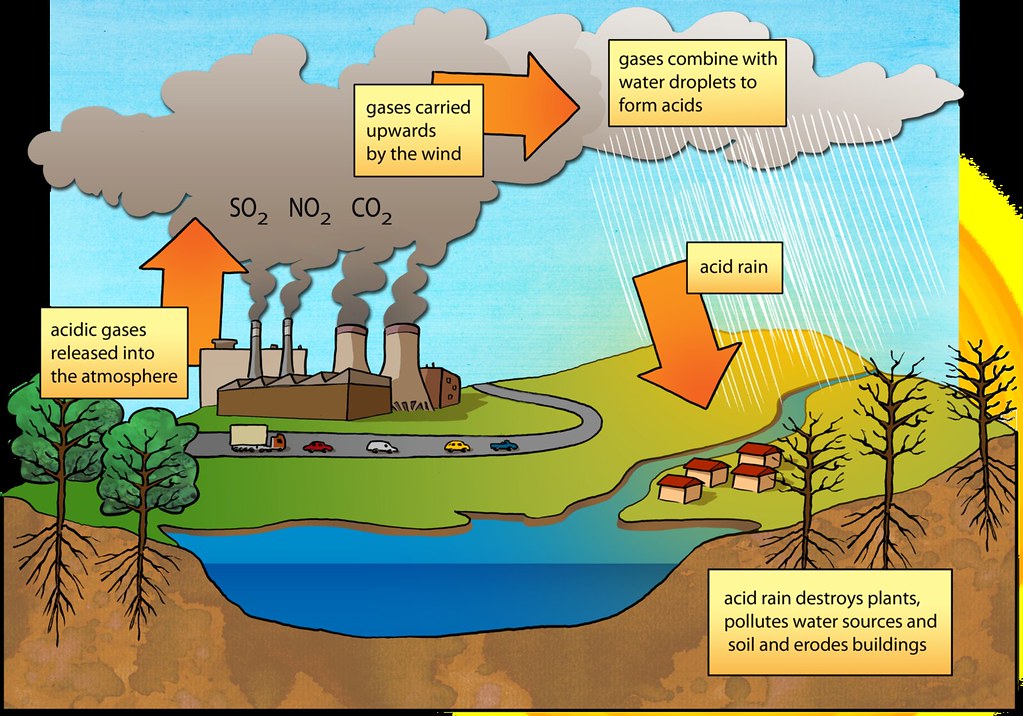
Source: Fiveable — Acid Rain Formation and Effects | Environmental Chemistry ... · fiveable.me
Major trap: Assuming all nitrogen release helps plants — burning sends nitrogen to AIR, decomposition sends it to SOIL
Memory trick: Coal = Air pollution, Compost = Soil nutrition
Don't confuse: NOₓ pollution with nitrogen fertilization — they're opposite effects