Which of the following statements with regard to Green Hydrogen is/are correct ? 1. It is decarbonized hydrogen obtained from natural gas reforming combined with carbon capture and storage (CCS). 2. It is produced using electrolysis of water with electricity generated by renewable energy. 3. National Green Hydrogen Mission of India aims for abatement of nearly 50 MMT of annual greenhouse gas emissions by 2030. Select the answer using the code given below :
Contents18
- A1 only
- B2 and 3 only
- C2 only
- D1, 2 and 3
Show answer
Answer: (B) 2 and 3 only
The correct answer is 2 and 3 only.
Key Points
- Statement 1 is incorrect. What it describes is Blue Hydrogen, not green. Blue hydrogen comes from fossil fuels like natural gas through Steam Methane Reforming (SMR), but adds Carbon Capture and Storage (CCS) to trap the carbon dioxide produced. Green hydrogen uses no fossil fuels at all.
- Statement 2 is correct. Green Hydrogen is made by electrolysis of water, using electricity from renewable sources such as solar, wind or hydropower. Water splits into hydrogen and oxygen, with zero carbon emissions.
- Statement 3 is correct. The National Green Hydrogen Mission was launched by the Government of India in 2023. It targets a production capacity of at least 5 MMT (Million Metric Tonnes) per year by 2030. This is expected to cut nearly 50 MMT of annual greenhouse gas emissions.
Additional Information
- Hydrogen Color Spectrum:
- Grey Hydrogen: The most common method today. Extracted from natural gas by reforming, but the carbon dioxide escapes into the atmosphere.
- Brown/Black Hydrogen: Made by gasification of coal or lignite. Worst for the environment because of heavy CO2 release.
- Yellow Hydrogen: A subset of green hydrogen where the electrolysis runs specifically on solar energy.
- Pink Hydrogen: Electrolysis powered by nuclear energy.
- Mission Components:
- SIGHT Program (Strategic Interventions for Green Hydrogen Transition): gives financial incentives for making electrolyzers in India.
- Green Hydrogen Hubs: regional clusters for large-scale production and use.
- Energy Independence: aims to cut fossil fuel imports by over 1 lakh crore and attract investments of over 8 lakh crore by 2030.
India's National Green Hydrogen Mission launched in 2023 targets 5 MMT annual production capacity and 50 MMT greenhouse gas emission reduction by 2030.
UPSC is testing the distinction between green hydrogen (renewable electrolysis) and blue hydrogen (natural gas with carbon capture) - a common conceptual confusion.
The question checks understanding of India's hydrogen strategy as part of energy transition and net-zero commitments.
Green Hydrogen Production
Environment Green Hydrogen electrolysis renewable energy
Green Hydrogen: Production Process & Key Features
Green Hydrogen is produced by electrolysis of water using renewable electricity
Process splits water into hydrogen and oxygen with zero carbon emissions
Completely fossil fuel-free production method
Renewable sources include solar, wind, and hydropower
What is Green Hydrogen
Green Hydrogen is the cleanest form of hydrogen produced entirely from renewable energy. Unlike other hydrogen types, it involves zero fossil fuels and produces no carbon emissions during manufacturing.
Green Hydrogen Production Process
%%{init: {"flowchart": {"wrappingWidth": 460}}}%%
flowchart TD
  s1["`**Renewable Energy Generation**
**Solar panels, wind turbines, or hydropower** generate clean electricity`"]
  s2["`**Water Electrolysis**
Electric current passes through water in an **electrolyzer**`"]
  s3["`**Water Splitting**
H₂O splits into **hydrogen (H₂)** at cathode and **oxygen (O₂)** at anode`"]
  s4["`**Hydrogen Collection**
Pure **hydrogen gas** collected and stored for various applications`"]
  s1 --> s2
  s2 --> s3
  s3 --> s4
Key Advantages
Zero carbon footprint throughout production cycle
Uses abundant water resources as primary input
Can be produced anywhere with renewable energy access
Scalable technology suitable for industrial applications
Supports energy storage for grid balancing
Trap: Statement 1 describes Blue Hydrogen (natural gas + CCS), not Green Hydrogen
Green Hydrogen uses NO fossil fuels - only water and renewable electricity
Do not confuse electrolysis with Steam Methane Reforming (SMR)
Hydrogen Color Classification
Environment Blue Hydrogen natural gas reforming carbon capture
Hydrogen Color Spectrum: Production Methods & Carbon Footprint
Grey Hydrogen dominates current production using natural gas without CCS
Blue Hydrogen adds carbon capture to natural gas reforming
Green Hydrogen uses only renewable electricity and water
Colors indicate carbon intensity and production method
Classification Logic
Hydrogen is classified by colors based on production method and carbon emissions. The spectrum ranges from high-carbon Grey/Brown to zero-carbon Green, with intermediate options like Blue and Pink.
Hydrogen Types Comparison
Type | Production Method | Carbon Emissions | Key Feature |
|---|---|---|---|
Grey Hydrogen | Natural gas reforming (SMR) | High CO₂ release | Most common today (~95%) |
Blue Hydrogen | Natural gas + CCS technology | Reduced CO₂ | Transitional solution |
Brown/Black | Coal gasification | Highest emissions | Worst environmental impact |
Green Hydrogen | Water electrolysis + renewables | Zero emissions | Ultimate clean goal |
Yellow Hydrogen | Solar-powered electrolysis | Zero emissions | Solar-specific green variant |
Pink Hydrogen | Nuclear-powered electrolysis | Zero emissions | Nuclear energy variant |
UPSC Focus Areas
Blue vs Green distinction frequently tested in statements
Steam Methane Reforming (SMR) is the process for Grey/Blue hydrogen
Carbon Capture and Storage (CCS) differentiates Blue from Grey
Nuclear energy produces Pink hydrogen, not Green
Trap: Blue hydrogen still uses fossil fuels - only CCS reduces emissions
Green hydrogen requires renewable electricity - not just any clean electricity
Yellow and Pink are variants of green/clean, but Green specifically means renewables
National Green Hydrogen Mission
Environment National Green Hydrogen Mission 50 MMT greenhouse gas emissions 2030
National Green Hydrogen Mission: Targets & Components
Launched in 2023 with 5 MMT annual production target by 2030
Aims to cut 50 MMT greenhouse gas emissions annually
Expected to save ₹1 lakh crore in fossil fuel imports
Investment target of ₹8 lakh crore by 2030
Mission Overview
The National Green Hydrogen Mission was launched by the Government of India in 2023 as a comprehensive strategy to position India as a global hub for green hydrogen production and export.
Mission Targets by 2030
Parameter | Target | Impact |
|---|---|---|
Production Capacity | 5 MMT per year | Meet domestic demand + exports |
GHG Emission Reduction | 50 MMT annually | Significant climate contribution |
Import Savings | ₹1 lakh crore | Reduced fossil fuel dependency |
Investment Attraction | ₹8 lakh crore | Economic growth and jobs |
Renewable Energy | 125 GW additional | Grid capacity expansion |
Mission Components
# National Green Hydrogen Mission
## SIGHT Program
- Electrolyzer manufacturing incentives
- Strategic interventions
- Technology development
## Green Hydrogen Hubs
- Regional production clusters
- Industrial integration
- Export facilities
## Policy Framework
- Regulatory standards
- Safety protocols
- Quality certification
## R&D Support
- Technology innovation
- Cost reduction
- Efficiency improvement
Strategic Importance
Energy independence from fossil fuel imports
Export potential to global markets requiring clean hydrogen
Industrial decarbonization for steel, cement, and chemical sectors
Grid balancing through hydrogen storage systems
50 MMT emission reduction is correct for Statement 3 - memorize this number
Mission launched in 2023, not earlier - recent policy initiative
5 MMT production target by 2030, not 50 MMT production
Hydrogen Economy Applications
Environment
Hydrogen Economy: Applications & Market Potential
Steel and cement industries are major hydrogen consumers for decarbonization
Fuel cells convert hydrogen to electricity for vehicles and grid storage
Ammonia production for fertilizers is largest current hydrogen use
Energy storage potential for renewable grid integration
Economic Significance
The hydrogen economy represents industries and applications where hydrogen serves as clean fuel or industrial input. Current global hydrogen demand is 70-75 million tonnes annually, mostly grey hydrogen.
Major Hydrogen Applications
Sector | Application | Current Status | Green Hydrogen Potential |
|---|---|---|---|
Industrial | Steel production (DRI) | Coal/coke dependent | Zero carbon steel |
Chemicals | Ammonia/fertilizer production | Grey hydrogen dominant | Clean fertilizer supply |
Transportation | Fuel cell vehicles | Limited deployment | Heavy trucks, ships |
Energy Storage | Grid balancing | Pilot projects | Seasonal storage |
Refining | Oil processing | Grey hydrogen used | Cleaner refining process |
India's Priority Sectors
Steel industry decarbonization - replace coking coal with hydrogen
Fertilizer production - reduce import dependency on ammonia
Heavy transportation - trucks, buses, and shipping fuel
Export opportunities to Japan, South Korea, and Europe
Hydrogen Value Chain
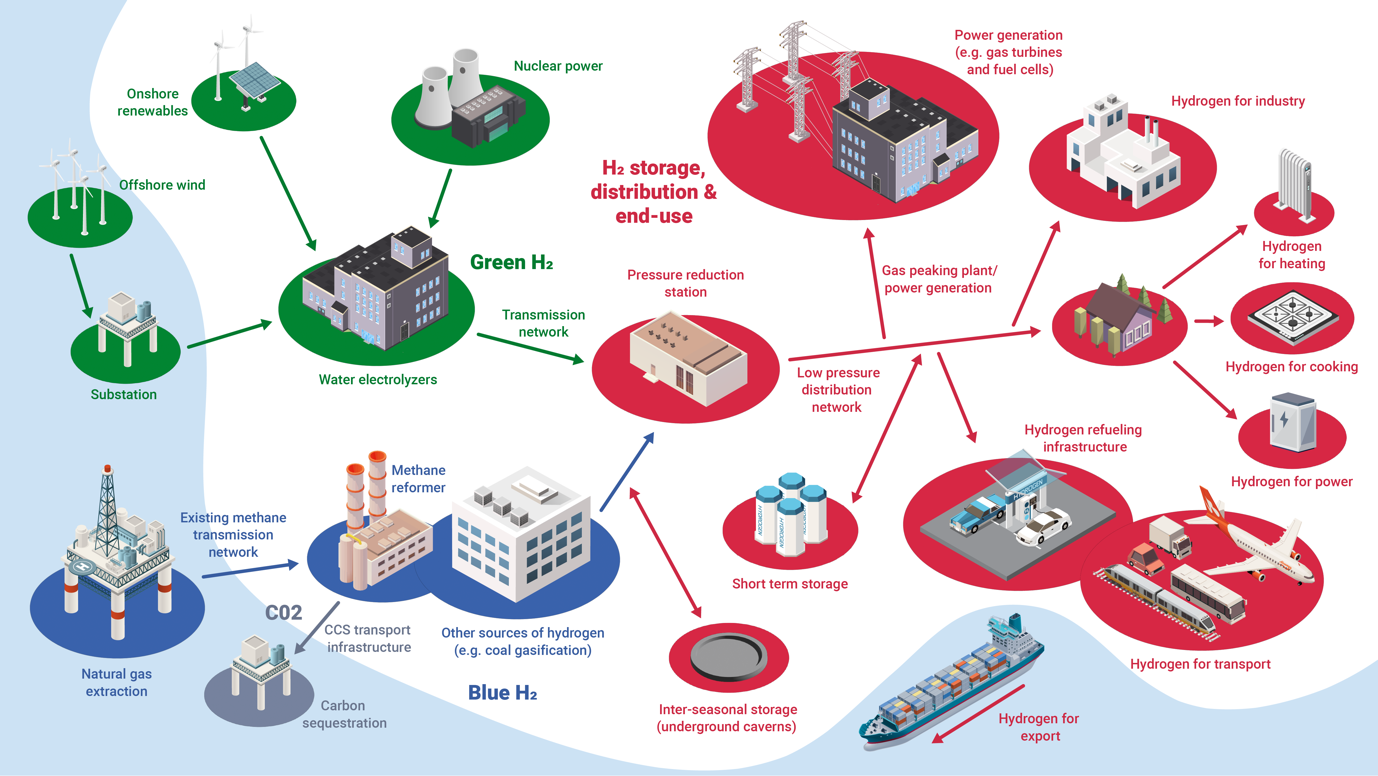
Source: IDTechEx — The Hydrogen Value Chain, Emerging Power and Aviation Applications | IDTechEx Research Article · www.idtechex.com