Which one of the following best describes the 'Crowding Out Effect' in the context of fiscal policy ?
Contents17
- AA situation where private investment increases due to increased Government spending
- BA situation where Government borrowing leads to higher interest rates, which reduces private investment
- CA situation where an increase in taxes leads to increased private sector investment
- DA situation where Government spending has no impact on aggregate demand
Show answer
Answer: (B) A situation where Government borrowing leads to higher interest rates, which reduces private investment
The correct answer is A situation where Government borrowing leads to higher interest rates, which reduces private investment.
Key Points
- The Crowding Out Effect is the idea that rising public sector spending pushes down, or even wipes out, private sector spending.
- When a government follows an Expansionary Fiscal Policy (spending more or cutting taxes), it usually runs a Budget Deficit. To fund that deficit, it borrows by issuing bonds.
- More government borrowing means more demand for loanable funds in the financial market. This pushes interest rates up.
- Higher interest rates raise the cost of borrowing for private firms and consumers. So companies cancel or postpone capital investment projects, and households cut back on big purchases. Private economic activity gets "crowded out".
- Option A is wrong. It describes Crowding In, where government spending builds infrastructure or creates demand that pulls in private investment.
- Option C is wrong. Higher taxes normally leave people with less disposable income to invest, not more.
- Option D is wrong. It describes Fiscal Neutrality, not crowding out.
Additional Information
- In the IS-LM Model, crowding out shows up as a rightward shift of the IS Curve. Gross Domestic Product (GDP) rises, but the interest rate also rises along the LM Curve, which stops the economy from reaching its full potential output.
- Classical economists often say crowding out is almost 100% complete. Every rupee of government spending replaces a rupee of lost private investment, so fiscal policy achieves nothing.
- Keynesian economists disagree. In a Liquidity Trap or a deep recession, crowding out is small because savings are in excess supply and private investment is already weak due to poor expectations.
- How much crowding out happens depends on the interest elasticity of investment and the income velocity of money.
India's fiscal deficit has remained above 3% of GDP for over a decade, making government borrowing and its effects on private investment a critical policy concern.
The question tests whether students understand that government borrowing competes with private sector for the same pool of savings, driving up interest rates and reducing private investment.
Students must distinguish crowding out from crowding in effects and understand the transmission mechanism through interest rates in financial markets.
Crowding Out Effect
Indian Economy Crowding Out Effect Government borrowing private investment
Crowding Out Effect: Mechanism & Economic Impact
Crowding Out Effect occurs when government borrowing raises interest rates and reduces private investment
Higher interest rates increase borrowing costs for private firms and households
Mechanism: Government deficit → More borrowing → Higher demand for loanable funds → Higher interest rates → Lower private investment
Opposite of Crowding In, where government spending attracts private investment
What It Is
The Crowding Out Effect describes how government borrowing can reduce private sector investment by pushing up interest rates. When government competes with private borrowers for the same pool of savings, it drives up the cost of borrowing for everyone.
How Crowding Out Works
%%{init: {"flowchart": {"wrappingWidth": 460}}}%%
flowchart TD
  s1["`**Expansionary Fiscal Policy**
Government increases spending or cuts taxes`"]
  s2["`**Budget Deficit**
Government expenditure exceeds revenue`"]
  s3["`**Government Borrowing**
Issues bonds to fund the deficit`"]
  s4["`**Higher Demand for Loanable Funds**
Government competes with private sector for savings`"]
  s5["`**Interest Rates Rise**
Cost of borrowing increases across the economy`"]
  s6["`**Private Investment Falls**
Firms postpone projects, households reduce spending`"]
  s1 --> s2
  s2 --> s3
  s3 --> s4
  s4 --> s5
  s5 --> s6
Crowding Out vs Related Concepts
Effect | Government Action | Interest Rates | Private Investment | Example |
|---|---|---|---|---|
Crowding Out | Deficit spending + Borrowing | Rise | Falls | Infrastructure bonds push up rates |
Crowding In | Productive spending | May rise | Rises | Metro project attracts real estate investment |
Fiscal Neutrality | Balanced budget | Unchanged | Unchanged | Tax increase = Spending increase |
Question Connection
This PYQ tests the core mechanism of crowding out. Option B correctly identifies the government borrowing → higher interest rates → reduced private investment chain. The trap options mix up crowding in (A), tax effects (C), and fiscal neutrality (D).
Trap: Confusing Crowding Out with Crowding In — government spending can sometimes attract private investment
Trap: Thinking higher taxes automatically boost private investment — they usually reduce disposable income instead
Trap: Assuming government spending has zero economic impact — this describes fiscal neutrality, not crowding out
Fiscal Policy Mechanisms
Indian Economy fiscal policy Expansionary Fiscal Policy
Fiscal Policy Tools & Economic Transmission
Expansionary Fiscal Policy increases government spending or cuts taxes to boost economic activity
Contractionary Fiscal Policy reduces spending or raises taxes to cool down the economy
Fiscal policy affects aggregate demand directly through government purchases and indirectly through household income
Fiscal Policy Tools
# Fiscal Policy
## Expansionary
- Increase Government Spending
- Cut Income Tax
- Cut Corporate Tax
- Increase Subsidies
## Contractionary
- Reduce Government Spending
- Raise Income Tax
- Raise Corporate Tax
- Cut Subsidies
## Automatic Stabilizers
- Progressive Taxation
- Unemployment Benefits
- Social Security Payments
Fiscal Policy Transmission Channels
Channel | How It Works | Time Lag | Effectiveness |
|---|---|---|---|
Direct Government Spending | G↑ → AD↑ → GDP↑ | Immediate | High certainty |
Tax Multiplier | T↓ → Disposable Income↑ → C↑ → AD↑ | 3-6 months | Depends on savings rate |
Investment Incentives | Tax breaks → Business investment↑ | 6-12 months | Depends on business confidence |
Transfer Payments | Subsidies → Household spending↑ | 1-3 months | High for low-income groups |
Trap: Mixing up fiscal policy (government spending/taxation) with monetary policy (interest rates/money supply)
Trap: Assuming fiscal expansion always works — effectiveness depends on economic conditions and crowding out
IS-LM Model
Indian Economy
IS-LM Model: Interest Rates & Economic Output
IS Curve shows combinations of interest rates and GDP where goods market is in equilibrium
LM Curve shows combinations where money market is in equilibrium
Intersection of IS and LM curves determines equilibrium interest rate and GDP
Model Overview
The IS-LM Model explains how fiscal and monetary policies interact to determine interest rates and national income. It shows why fiscal expansion can be partially offset by rising interest rates.
IS-LM Curve Characteristics
Curve | Full Name | Slope | What It Shows | Shifts Right When |
|---|---|---|---|---|
IS | Investment-Savings | Downward | Goods market equilibrium | Government spending↑, Taxes↓ |
LM | Liquidity-Money | Upward | Money market equilibrium | Money supply↑, Price level↓ |
Crowding Out in IS-LM Framework
%%{init: {"flowchart": {"wrappingWidth": 460}}}%%
flowchart TD
  s1["`**Fiscal Expansion**
Government increases spending (G↑)`"]
  s2["`**IS Curve Shifts Right**
Higher aggregate demand at each interest rate`"]
  s3["`**Movement Along LM Curve**
Higher income increases money demand`"]
  s4["`**Interest Rate Rises**
Money market equilibrium requires higher rates`"]
  s5["`**Private Investment Falls**
Higher rates crowd out some investment`"]
  s6["`**Partial GDP Increase**
Net effect smaller than initial fiscal stimulus`"]
  s1 --> s2
  s2 --> s3
  s3 --> s4
  s4 --> s5
  s5 --> s6
IS-LM Graph
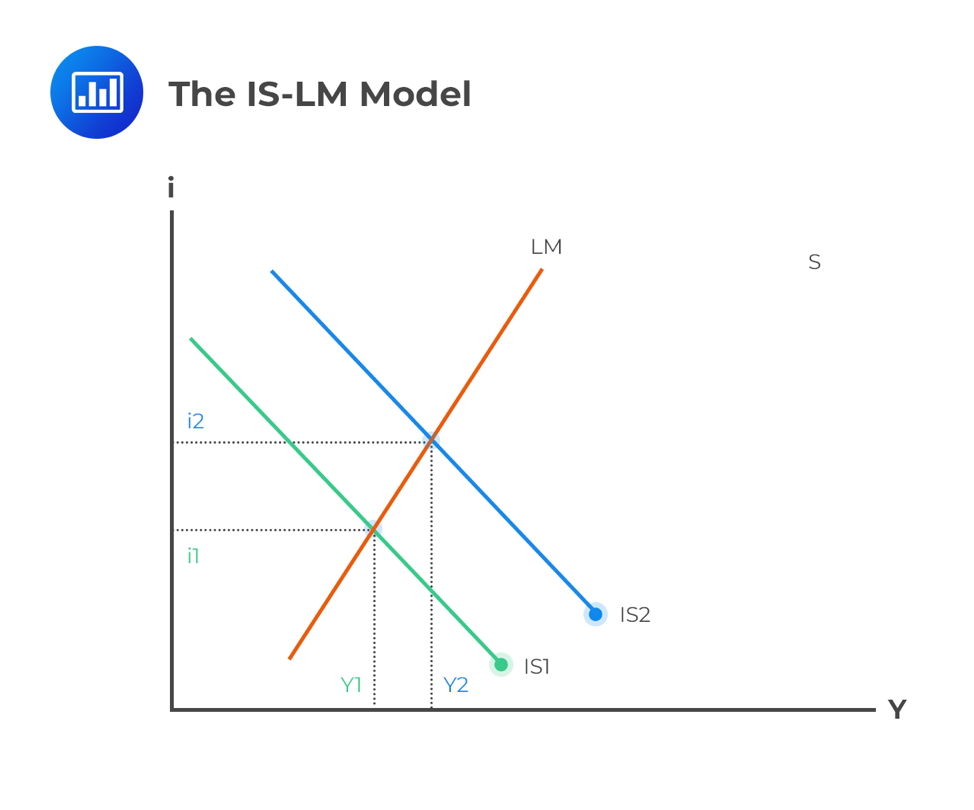
Source: Analyst Prep — IS-LM Curves & Aggregate Demand | CFA Level 1 · analystprep.com
Classical vs Keynesian Economics
Indian Economy
Classical vs Keynesian Views on Crowding Out
Classical economists believe crowding out is nearly 100% — fiscal policy is ineffective
Keynesian economists argue crowding out is limited during recessions and liquidity traps
The debate centers on interest elasticity of investment and economic conditions
Classical vs Keynesian Perspectives
Aspect | Classical View | Keynesian View | Policy Implication |
|---|---|---|---|
Crowding Out Extent | Complete (100%) | Partial or minimal | Fiscal policy ineffective vs effective |
Private Investment | Highly sensitive to rates | Less sensitive during recessions | Focus on monetary vs fiscal policy |
Market Clearing | Markets always clear | Markets can have persistent unemployment | Hands-off vs active intervention |
Long-run Focus | Economy self-corrects quickly | Long adjustment periods | Short-run stability less vs more important |
When Crowding Out is Limited
Liquidity Trap: Interest rates near zero, so fiscal expansion doesn't push them up much
Deep Recession: Private investment already low due to poor business expectations, not high interest rates
Excess Savings: High unemployment means lots of idle savings available for government borrowing
Credit Market Segmentation: Government and private borrowers may tap different funding sources
Modern Synthesis
Most economists now agree that crowding out varies with economic conditions. During normal times with full employment, crowding out is significant. During recessions or financial crises, fiscal policy faces less crowding out and can be more effective.
Trap: Assuming crowding out is always 100% — Keynesians show it depends on economic conditions
Trap: Confusing liquidity trap (interest rates stuck at zero) with normal monetary policy transmission