Consider the following statements about the archaeological findings in Harappan towns : I. There is wide occurrence of spindle-whorls in the houses but absence of spinning wheels. II. Weights and measurement scales, complete with graduations have been discovered. III. There are houses built in large part with baked bricks, around relatively spacious courtyards, with their own wells, bathing platforms, and large rooms. Which of the following inferences can be drawn from the above statements ? 1. Statement I suggests that spinning was a laborious activity done at home. 2. Statement II suggests the extent of the scientific knowledge that the Harappans possessed. 3. Statement III suggests the emergence of a common property system. Select the answer using the code given below :
Contents17
- A1 and 2 only
- B2 and 3 only
- C1 and 3 only
- D1, 2 and 3
Show answer
Answer: (A) 1 and 2 only
The correct answer is 1 and 2 only.
Key Points
- Inference 1 is correct. Spindle-whorls made of terracotta and faience are found in almost every household. This shows that spinning cotton and wool was a common domestic task. Mechanized spinning wheels had not been invented yet, so the work was manual and took much time and effort.
- Inference 2 is correct. The Harappan civilization used highly standardized weights and measurement scales. Excavations have revealed cubical chert weights and graduated scales made of shell, ivory, and metal. These objects show an advanced understanding of mathematics, geometry, and precision engineering.
- Inference 3 is incorrect. Private wells, bathing platforms, and baked brick houses with large rooms and central courtyards stress individual household privacy and private property. A common property system would instead mean shared public facilities for daily living, which goes against this evidence of self-contained domestic units.
Additional Information
- Textile Industry:
- Actual pieces of dyed cotton cloth have been found at Mohenjo-daro.
- The spindle-whorls suggest that weaving was a widespread cottage industry.
- Metrology and Trade:
- The weight system followed a binary system for lower denominations (1, 2, 4, 8, 16, 32, up to 12,800) and a decimal system for higher weights.
- Standardization was maintained across vast distances, from Gujarat to Punjab.
- Architectural Features:
- Baked bricks were made in a uniform ratio of 1:2:4 (thickness to width to length).
- Drainage systems were carefully planned. Individual house drains connected to street sewers made of mortar and gypsum.
The Harappan civilization had uniform weights, measures, and brick sizes across thousands of kilometers, showing remarkable administrative control and trade networks.
UPSC is testing whether students can distinguish between evidence of private property systems versus communal living arrangements in ancient civilizations.
The question checks if students can make correct logical inferences from archaeological evidence rather than just memorizing facts about Harappan discoveries.
Harappan Textile Industry
Ancient And Medieval History spindle-whorls spinning houses
Harappan Textile Industry: Spindle-Whorls & Domestic Production
Spindle-whorls found in almost every Harappan house indicate widespread domestic spinning
No spinning wheels existed - all textile work was manual and time-consuming
Actual dyed cotton cloth pieces discovered at Mohenjo-daro
Textile production was a cottage industry spread across households
Archaeological Evidence
Spindle-whorls made of terracotta and faience appear in virtually every excavated Harappan house, suggesting that spinning cotton and wool was a routine domestic task performed by household members.
Textile Production Evidence
Artifact Type | Material | Function | Significance |
|---|---|---|---|
Spindle-whorls | Terracotta, Faience | Hand-spinning thread | Universal domestic activity |
Cotton cloth pieces | Dyed cotton | Finished textile | Advanced dyeing techniques |
Spinning wheels | Absent | Mechanized spinning | Pre-industrial technology level |
Production Characteristics
Spinning was manual and laborious without mechanized wheels
Every household participated in textile production as a cottage industry
Cotton cultivation and processing were well-developed skills
Dyeing technology was sophisticated enough to create colored fabrics
Trap: Confusing spindle-whorls with spinning wheels - whorls are hand tools, wheels are machines
Trap: Assuming absence of spinning wheels means no textile industry - manual spinning was highly developed
Harappan Weights & Measurements
Ancient And Medieval History weights measurement scales graduations
Harappan Metrology: Standardized Weights & Scientific Precision
Cubical chert weights following binary and decimal systems discovered
Graduated scales made of shell, ivory, and metal found across sites
Weight ratio followed 1:2:4 standardization across vast distances
Demonstrates advanced mathematics and precision engineering knowledge
Scientific Achievement
The discovery of standardized weights and graduated measurement scales across Harappan sites demonstrates sophisticated understanding of mathematics, geometry, and precision engineering - indicating advanced scientific knowledge for a Bronze Age civilization.
Weight Systems Used
System Type | Denominations | Materials | Application |
|---|---|---|---|
Binary System | 1, 2, 4, 8, 16, 32 up to 12,800 | Chert stone | Lower denominations |
Decimal System | Multiples of 10 | Stone, metal | Higher weights |
Measurement Scales | Graduated markings | Shell, ivory, metal | Linear measurements |
Standardization Features
Uniform standards maintained from Gujarat to Punjab across 1000+ km
Cubical weights made primarily of chert stone for durability
Scales show precise graduations indicating fractional measurements
Trade and commerce required this level of measurement precision
Harappan Weights
Photograph showing cubical chert weights of different sizes from Harappan excavations with measurement scale
Cubical chert weights following binary progression - evidence of advanced mathematical knowledge
Trap: Confusing weight systems - lower denominations used binary, higher used decimal
Trap: Assuming modern measurement units - Harappans had their own standardized system
Harappan Architecture & Housing
Ancient And Medieval History baked bricks courtyards wells bathing platforms
Harappan Housing: Private Architecture & Urban Planning
Houses built with baked bricks in 1:2:4 ratio around spacious courtyards
Private wells and bathing platforms in individual houses
Evidence supports private property system, not common property
Advanced drainage systems connected house drains to street sewers
Architectural Evidence
Harappan houses featured private wells, bathing platforms, and spacious courtyards within individual family compounds, clearly indicating a private property system rather than communal living arrangements.
House Features & Implications
Architectural Feature | Construction Details | Social Implication |
|---|---|---|
Private Wells | Individual water sources per house | Self-sufficient households |
Bathing Platforms | Brick-lined bathing areas | Personal hygiene emphasis |
Courtyards | Central open spaces | Private family gathering areas |
Baked Bricks | 1:2:4 ratio standardization | Advanced construction technology |
Large Rooms | Multi-room layouts | Prosperous family living |
Urban Planning Features
Drainage systems with house drains connecting to street sewers made of mortar and gypsum
Baked brick construction in uniform 1:2:4 ratio (thickness:width:length)
Houses designed as self-contained domestic units with private amenities
Street planning followed grid pattern with proper waste management
Harappan House Layout
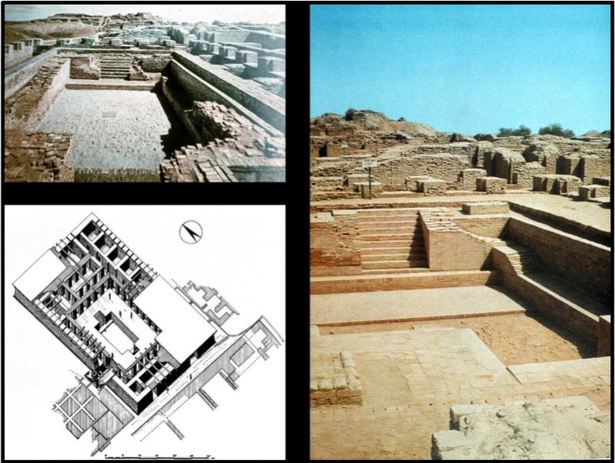
Source: HISTORY'S HISTORIES You are history. We are the future. — India Indus Valley Civilization Activity - HISTORY'S HISTORIES You are history. We are the future. · www.historyshistories.com
Trap: Inferring common property from good planning - private amenities actually prove individual ownership
Trap: Confusing urban planning with socialism - Harappans had private households with public infrastructure
Harappan Civilization Features
Ancient And Medieval History
Harappan Civilization: Key Archaeological & Cultural Features
Bronze Age civilization (c. 2600-1900 BCE) in Indus Valley region
Standardization across settlements from Gujarat to Punjab
Advanced urban planning with drainage, grid streets, and public baths
Evidence of trade networks and sophisticated craftsmanship
Civilization Characteristics
# Harappan Civilization
## Technology
- Bronze working
- Baked brick making
- Precision weights
- Drainage engineering
## Economy
- Agriculture
- Craft production
- Long-distance trade
- Standardized currency
## Society
- Urban settlements
- Private property
- Skilled artisans
- Social stratification
## Culture
- Undeciphered script
- Religious practices
- Art and seals
- Personal hygiene
Major Harappan Sites
Site | Location | Key Discovery | Significance |
|---|---|---|---|
Harappa | Punjab, Pakistan | Granaries, citadel | Type site of civilization |
Mohenjo-daro | Sindh, Pakistan | Great Bath, priest-king statue | Best preserved urban center |
Dholavira | Gujarat, India | Water management, signboard | Advanced hydraulic engineering |
Lothal | Gujarat, India | Dockyard, bead making | Maritime trade center |
Trap: Confusing Harappan with later Vedic culture - they are separate civilizations
Trap: Assuming deciphered script - Harappan writing remains undeciphered
Trap: Overestimating egalitarian society - evidence shows social hierarchy and private wealth