Which of the following best explain(s) the rationale for protecting mangrove ecosystems in the context of climate resilience ? 1. Mangroves reduce tidal energy and store freshwater, making them ideal sites for paddy cultivation in saline estuarine belts. 2. Their salt-sensitive roots filter seawater, making mangroves key to converting coastal land into freshwater aquaculture zones. 3. By withstanding tidal surges and offering biomass resources, mangroves function both as natural bio-shields and livelihood bases for rural communities. Select the answer using the code given below :
Contents24
- A1 only
- B1 and 2
- C2 and 3
- D3 only
Show answer
Answer: (D) 3 only
The correct answer is 3 only.
Key Points
- Statement 1 is incorrect. Mangroves grow in intertidal zones, where the water is highly saline and brackish. They do cut down tidal energy, but they do not store freshwater for farming. Clearing mangrove land for paddy usually causes ecological damage and soil acidification.
- Statement 2 is incorrect. Mangrove roots are not salt-sensitive. Mangroves are halophytes (salt-tolerant plants). They survive in saline water using special features like salt-excluding membranes and salt-excreting glands. Also, turning these areas into freshwater aquaculture zones destroys the habitat — the opposite of protecting it.
- Statement 3 is correct. Mangroves act as natural bio-shields. Their dense roots, such as pneumatophores and prop roots, absorb the force of tsunamis, cyclones and storm surges. They also support livelihoods by sustaining fisheries and supplying biomass like honey, medicinal plants and sustainable timber.
Additional Information
- Climate resilience and adaptation:
- Blue Carbon: Mangroves store far more carbon per unit area than land-based tropical forests, so they help mitigate climate change.
- Biodiversity hubs: They are important nursery grounds for many marine species and shelter endangered animals such as the Royal Bengal Tiger in the Sundarbans.
- Soil stabilisation: Their complex roots trap sediment and hold the shoreline together, preventing coastal erosion as sea levels rise.
- Viviparity: In this unusual reproductive trait, seeds germinate while still attached to the parent tree, helping seedlings survive on unstable, saline mudflats.
Mangroves store more carbon per unit area than tropical forests and act as natural barriers against cyclones and tsunamis, making them critical for both climate mitigation and adaptation strategies.
The 2004 Indian Ocean tsunami highlighted how mangrove destruction increased coastal vulnerability, while areas with intact mangroves suffered less damage, leading to renewed focus on mangrove conservation for climate resilience.
UPSC is testing whether students can distinguish between actual mangrove characteristics versus common misconceptions about salt sensitivity and freshwater storage.
Mangrove Ecosystems & Climate Resilience
Environment mangrove ecosystems climate resilience tidal surges bio-shields
Mangrove Ecosystems: Natural Bio-shields for Climate Resilience
Mangroves are halophytes that thrive in saline intertidal zones, not freshwater environments
Act as natural bio-shields against tsunamis, cyclones, and storm surges through dense root systems
Store more carbon per unit area than tropical forests, making them crucial for climate mitigation
Support coastal livelihoods through fisheries, honey, medicinal plants, and sustainable timber
What Are Mangroves
Mangroves are salt-tolerant trees and shrubs that grow in intertidal zones where rivers meet the sea. These unique ecosystems thrive in brackish water and serve as critical buffers between land and ocean.
Climate Resilience Functions
Function | Mechanism | Climate Benefit | Example |
|---|---|---|---|
Coastal Protection | Dense roots absorb wave energy | Reduces storm surge damage | Pneumatophores and prop roots break tsunami force |
Carbon Storage | Blue carbon sequestration | Climate change mitigation | Store 3-4x more carbon than rainforests |
Soil Stabilization | Root systems trap sediment | Prevents erosion from sea level rise | Complex root networks hold shoreline |
Biodiversity Support | Nursery grounds for marine species | Ecosystem resilience | Royal Bengal Tiger habitat in Sundarbans |
Salt Tolerance Adaptations
Salt-excluding membranes in roots filter out salt from seawater during uptake
Salt-excreting glands in leaves actively remove excess salt from plant tissues
Viviparity - seeds germinate while attached to parent tree for better survival
Pneumatophores (aerial roots) help with gas exchange in waterlogged soils
Livelihood Resources
# Mangrove Livelihoods
## Fisheries
- Fish breeding grounds
- Crab harvesting
- Shrimp farming
## Forest Products
- Honey collection
- Medicinal plants
- Sustainable timber
## Eco-tourism
- Bird watching
- Boat tours
- Wildlife photography
Mangrove Root Systems
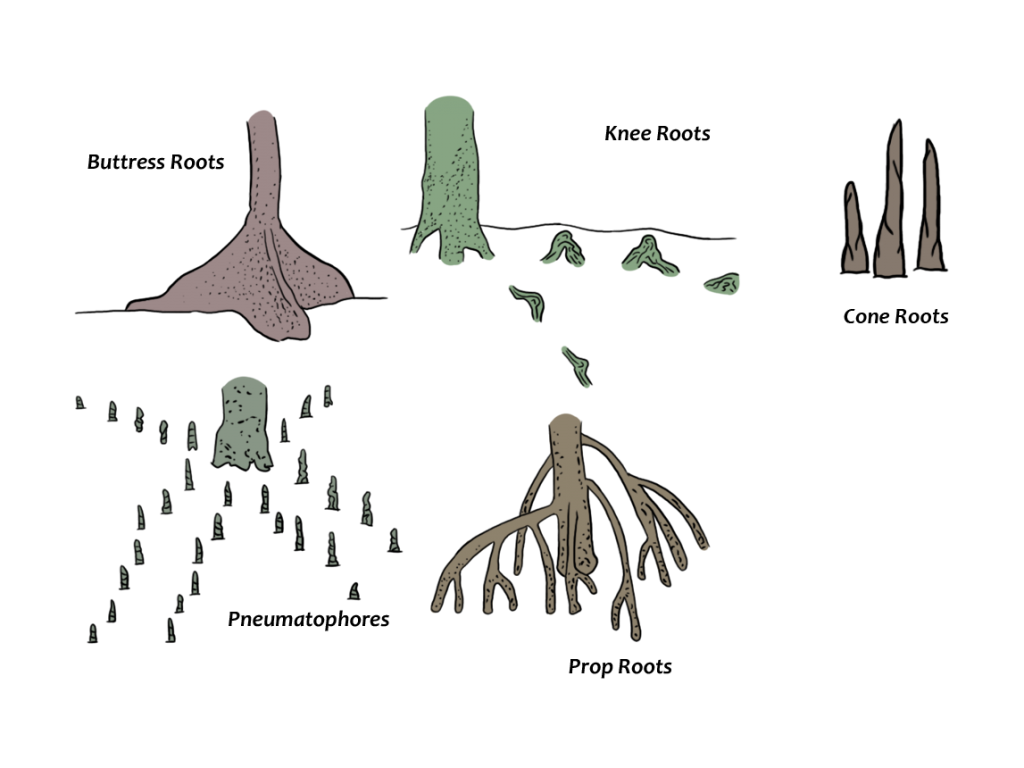
Source: Coastal Conservation and Education Foundation — What are mangroves? - CCEF · www.coast.ph
Trap: Mangroves store freshwater - they actually thrive in saline/brackish water
Trap: Salt-sensitive roots - mangrove roots are salt-tolerant, not sensitive
Trap: Converting to aquaculture protects mangroves - this actually destroys the ecosystem
Trap: Paddy cultivation in mangrove areas - causes soil acidification and ecological damage
Halophytes & Salt Tolerance Mechanisms
Environment salt-sensitive halophytes
Halophytes: How Plants Survive in Saline Environments
Halophytes are salt-tolerant plants that thrive in saline conditions unlike glycophytes
Use salt exclusion, salt secretion, and salt accumulation strategies
Mangroves are classic examples with specialized root and leaf adaptations
Halophytes vs Glycophytes
Halophytes are plants adapted to high-salt environments, while glycophytes are regular plants that cannot tolerate salt. Most crop plants are glycophytes and suffer from osmotic stress in saline soils.
Salt Tolerance Strategies
Strategy | Mechanism | Example Plants | Effectiveness |
|---|---|---|---|
Salt Exclusion | Roots filter salt from water uptake | Mangroves, some grasses | Prevents salt entry |
Salt Secretion | Specialized glands excrete salt | Mangroves, salt marsh plants | Active salt removal |
Salt Accumulation | Store salt in vacuoles away from enzymes | Salicornia, some succulents | Dilutes salt concentration |
Osmotic Adjustment | Produce compatible solutes | Many halophytes | Maintains water balance |
Salt Stress Response
%%{init: {"flowchart": {"wrappingWidth": 460}}}%%
flowchart TD
  s1["`**Salt Exposure**
Plant encounters high salinity in soil or water`"]
  s2["`**Osmotic Stress**
Water moves out of plant cells, causing dehydration`"]
  s3["`**Ion Toxicity**
Excess Na+ and Cl- ions disrupt enzyme function`"]
  s4["`**Adaptive Response**
Halophytes activate exclusion, secretion, or accumulation mechanisms`"]
  s5["`**Survival**
Plant maintains growth and reproduction in saline environment`"]
  s1 --> s2
  s2 --> s3
  s3 --> s4
  s4 --> s5
Indian Halophyte Examples
Sundarbans mangroves - largest mangrove ecosystem with multiple halophytic species
Salicornia - edible halophyte being promoted as alternative crop in saline wastelands
Suaeda and Arthrocnemum - salt marsh plants in Rann of Kutch
Prosopis juliflora - invasive halophyte causing ecological problems
Trap: All coastal plants are halophytes - many coastal plants are actually salt-sensitive
Trap: Halophytes need salt to survive - they tolerate salt but don't necessarily require it
Trap: Salt-tolerant means freshwater-intolerant - most halophytes can survive in both conditions
Blue Carbon Ecosystems
Environment
Blue Carbon: Coastal Ecosystems as Climate Solutions
Blue carbon refers to carbon stored in coastal and marine ecosystems
Mangroves store 3-4 times more carbon per unit area than tropical rainforests
Include mangroves, seagrass beds, and salt marshes as primary blue carbon ecosystems
Why Blue Carbon Matters
Blue carbon ecosystems are among the most efficient carbon sinks on Earth. Despite covering less than 1% of ocean area, they store 50% of oceanic carbon in sediments that can remain locked for millennia.
Blue Carbon Ecosystem Comparison
Ecosystem | Carbon Storage Rate | Storage Duration | Additional Benefits |
|---|---|---|---|
Mangroves | 1,000+ tons CO₂/hectare | Thousands of years | Coastal protection, fisheries |
Seagrass Beds | 350+ tons CO₂/hectare | Hundreds of years | Fish nurseries, water filtration |
Salt Marshes | 400+ tons CO₂/hectare | Hundreds of years | Storm buffers, bird habitat |
Tropical Forests | 250-300 tons CO₂/hectare | Decades to centuries | Biodiversity, timber |
Carbon Storage Mechanisms
Above-ground biomass - trees, stems, leaves store carbon in living tissue
Below-ground biomass - extensive root systems trap carbon in sediments
Anaerobic conditions - waterlogged soils slow decomposition, preserving carbon
Continuous burial - tidal action deposits sediments, creating carbon layers
Blue Carbon Benefits
# Blue Carbon Ecosystems
## Climate Mitigation
- CO₂ sequestration
- Long-term storage
- Emission reduction
## Climate Adaptation
- Storm protection
- Erosion control
- Sea level rise buffer
## Biodiversity
- Fish nurseries
- Bird habitat
- Marine species
## Livelihoods
- Fisheries
- Tourism
- Coastal communities
India's Blue Carbon Potential
Sundarbans - world's largest mangrove ecosystem shared with Bangladesh
Gujarat coastline - extensive mangrove coverage including Marine National Park
Pichavaram and Point Calimere - important mangrove areas in Tamil Nadu
Seagrass beds in Gulf of Mannar and Lakshadweep with high carbon potential
Trap: Blue carbon = ocean carbon - it specifically refers to coastal ecosystem carbon
Trap: All marine ecosystems store blue carbon - only mangroves, seagrass, salt marshes qualify
Trap: Blue carbon storage is temporary - it can last for thousands of years in sediments
Sundarbans Mangrove Ecosystem
Environment Royal Bengal Tiger Sundarbans
Sundarbans: World's Largest Mangrove Ecosystem
World's largest contiguous mangrove ecosystem spanning India and Bangladesh
Home to Royal Bengal Tigers adapted for swimming and mangrove life
UNESCO World Heritage Site covering approximately 10,000 sq km
Critical for blue carbon storage and cyclone protection for both countries
Geographic Significance
The Sundarbans forms at the confluence of Ganga, Brahmaputra, and Meghna rivers, creating the world's largest delta. About 40% lies in West Bengal, India while 60% is in Bangladesh.
Sundarbans Biodiversity
Category | Key Species | Conservation Status | Unique Adaptation |
|---|---|---|---|
Mammals | Royal Bengal Tiger | Endangered | Swimming ability, salt tolerance |
Reptiles | Saltwater Crocodile | Vulnerable | Salt glands for osmoregulation |
Birds | Masked Finfoot | Endangered | Webbed feet for mangrove streams |
Plants | Heritiera fomes | Critically Endangered | Pneumatophores for tidal zones |
Fish | Hilsa | Commercial importance | Anadromous migration pattern |
Ecological Services
Cyclone buffer - protects Kolkata and Dhaka from Bay of Bengal storms
Fisheries support - nursery grounds for commercial fish species
Carbon sink - stores millions of tons of blue carbon in sediments
Soil formation - traps sediment from three major river systems
Sundarbans Location

Source: Mongabay India — Sundarban Reserve Forest now a Wetland of International Importance · india.mongabay.com
Conservation Challenges
Sea level rise threatening low-lying islands and tiger habitat
Salinity intrusion affecting freshwater availability for communities
Human-tiger conflict as tigers swim between islands
Shrimp farming conversion reducing mangrove cover
Plastic pollution from upstream rivers affecting marine life
Tiger Adaptation Process
%%{init: {"flowchart": {"wrappingWidth": 460}}}%%
flowchart TD
  s1["`**Terrestrial Ancestor**
Regular tigers moved into Sundarbans centuries ago`"]
  s2["`**Tidal Environment**
Tigers encountered daily flooding and saltwater`"]
  s3["`**Swimming Adaptation**
Developed superior swimming skills for island hopping`"]
  s4["`**Salt Tolerance**
Evolved physiological mechanisms to handle saline water`"]
  s5["`**Unique Behavior**
Fish-eating, mangrove-climbing, swimming tigers`"]
  s1 --> s2
  s2 --> s3
  s3 --> s4
s4 --> s5Trap: Sundarbans only in India - it's a transboundary ecosystem with Bangladesh
Trap: All mangrove tigers are the same - Sundarbans tigers have unique adaptations
Trap: Largest delta = largest mangrove - Sundarbans is largest contiguous mangrove ecosystem